Before 5th Century
Before 400 AD, contact with Christian communities in Roman Britain might have introduced elements of Christianity to Ireland even before formal missionary efforts.
5th Century
Patrick, formerly a slave in Ireland, escaped but returned as a missionary in 432 to spread Christian teachings, converting chieftains and establishing churches. Palladius and Declan belong in the same era. Some say that Palladius arrived slightly before Patrick but didn’t have much success. Declan of Ardmore, Country Waterford, is said to have worked in Munster before Patrick arrived. Declan is credited with founding the monastery at Ardmore, which became a centre of Christian learning and worship
6th-7th Centuries
Monasticism arose in Ireland. Prominent monasteries included Clonmacnoise, County Offaly, Glendalough, County Wicklow, and Armagh. These were centres of scholarship, religious devotion, and manuscript preservation. Influential monks include the following:
- Columba or Colmcille (521-597) of Derry, who set up Iona, which, like Antioch in the New Testament, became a launch pad for Christian mission across Europe.
- Aidan who went to Lindisfarne and brought the gospel to Anglo Saxons. He is known as the Apostle of Northumbria.
- Columbanus who travelled across France, Switzerland and down to Italy.
- Brendan who travelled to Iceland and possibly to America.
At this time, Christianity was under threat across Europe. It’s often said that not only did Ireland help to save Christianity, but it also helped to save civilization itself. See How the Irish Saved Civilization.
Irish Christianity differed from Roman Christianity, particularly in how it calculated Easter and in its monastic structure, which sometimes contrasted with the Roman diocesan system. But more important was the personal faith of these early Irish Christians.
Finbar of Finn Barre, who died in 623, settled for about the last seventeen years of his life in the area then known as Corcach Mór na Mumhan (the Great Marsh of Munster), now the city of Cork, where he gathered around him monks and students. One of the most prominent buildings in Cork is St. Fin Barres Catherdral.
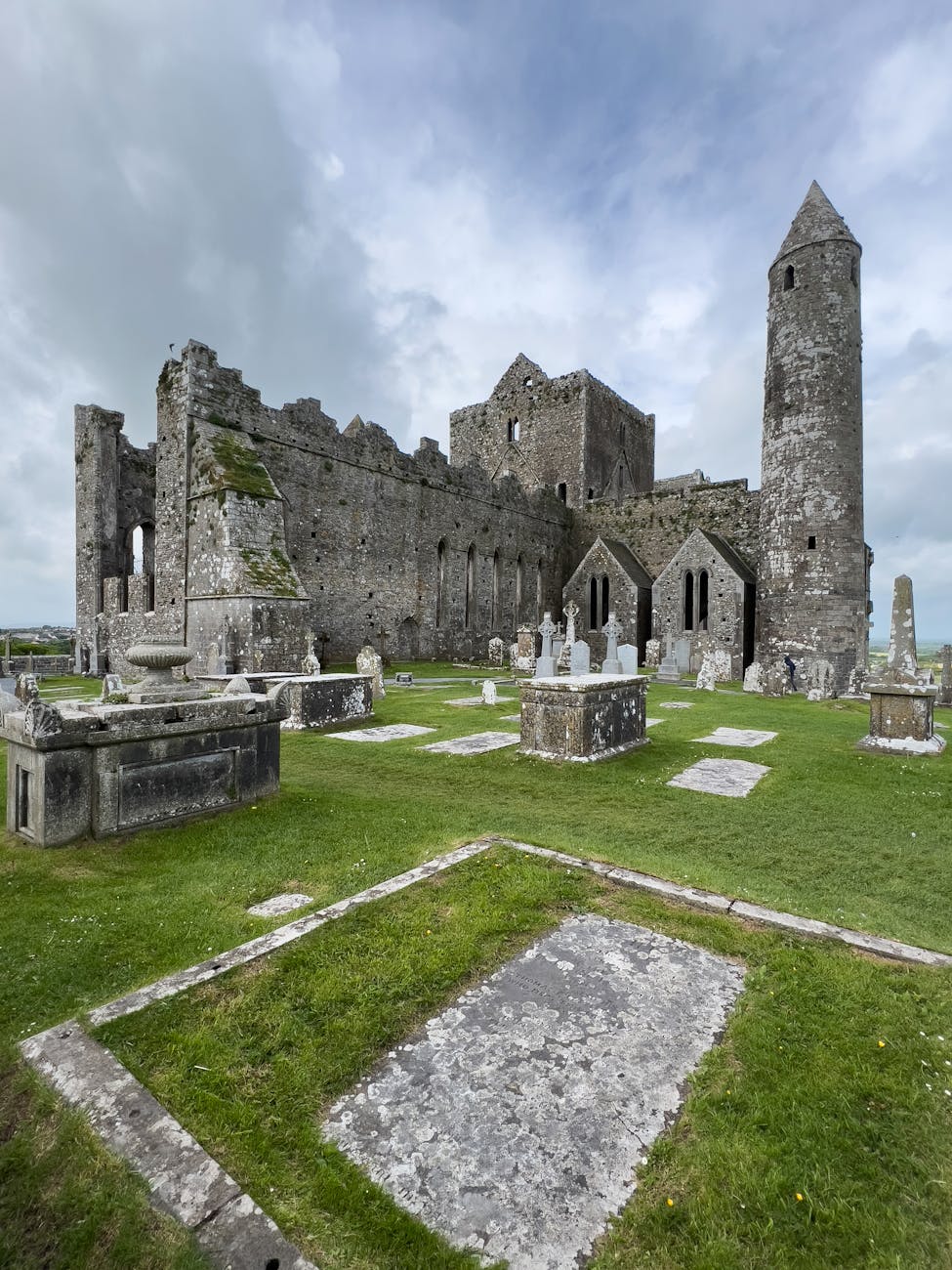
The monastery on Skellig Michael, which features in Star Wars The Force Awakens and The Last Jedi was founded sometime between the 6th and 8th centuries.
8th-9th Centuries
This is often seen as a golden age, when the Book of Kells was produced. The Irish church was highly respected across Europe, sending missionaries far and wide. Centres of learning flourished, preserving classical knowledge during the decline of Roman civilization.
The Vikings raided Clonmacnoise around 830 AD. This was part of a broader wave of Viking incursions into Ireland, targeting monastic sites rich in gold and silver. Clonmacnoise, being a major center of learning and religion, was a prime target.
9th-10th Centuries
Following Viking raids, some Irish monks fled to Europe, while others fortified monasteries, adapting to new realities. Viking settlements in Dublin, Limerick, and Waterford eventually became integrated into Irish life, and Christianity influenced Viking rulers. By 1000 AD, the Irish church saw increasing efforts to bring its practices in line with continental Europe, setting the stage for further reforms in the coming centuries.
11th-12th Centuries
The Synod of Cashel (1101) formally aligned Irish Christianity with the Roman Catholic Church, though reforms began earlier. The arrival of the Normans (1169) under King Henry II of England led to greater integration of the Irish church into European ecclesiastical structures. The Synods of Rathbreasail (1111) and Kells (1152) established the modern diocesan structure, replacing the monastic model with a more centralized episcopal system.
The introduction of Cistercian, Augustinian, and Franciscan orders strengthened reform efforts, building abbeys such as Mellifont Abbey (1142). English Pope, Adrian IV, granted the Laudabiliter bull (1155) to King Henry II, justifying English control over Irish church affairs.
So, it was England who brought Ireland under the authority of Rome. And Rome imposed Englishmen as Bishops and leaders of the Irish church.
In Limerick, Saint Mary’s Cathedral was started in the late twelfth century and was completed around 1194.
13th-14th Centuries
Anglo-Norman settlers built cathedrals and monastic communities, integrating Irish Christianity more into European traditions. Tension remained between the Gaelic Irish clergy and the Anglo-Norman church establishment, particularly regarding appointments to ecclesiastical positions.
14th-15th Centuries
The Statutes of Kilkenny (1366) imposed English cultural dominance, restricting Irish traditions, including within the church.
16th Century
King Henry VIII’s break with Rome (1534) led to the establishment of the Church of Ireland, making Protestantism the official state religion. Despite English efforts, most of the Irish population remained Catholic, resisting Protestant reforms. Because the papacy sought to regain control of England and urged Catholics to be disloyal, Catholics were regarded with suspicion and penal laws were introduced, which restricted Catholic worship and priesthood. Such laws were also applied to non-Anglican Protestants. At that time, you were expected to adopt the beliefs of your King or Queen. So, if you lived in England, under Henry VIII, you were Catholic until his divorce. Then you were Protestant, though Henry largely held on to Catholic beliefs and practices. Then, under his son, Edward VI, you were a proper Protestant until he died and Mary (bloody Mary) became Queen. Then you were Catholic again and then, under Elizabeth, you were Protestant again. Radicals such as Quakers and Baptists argued for freedom of religion but it would be along time before that came about. Even in the US, after the Pilgrim Fathers arrived, the question of how church related to state still caused disputes.
Little or none of the revival of learning during the Renaissance reached Ireland and the Scriptures weren’t available in Irish. It’s interesting how, Protestantism didn’t take root among the native Irish, whereas, Catholicism, also imposed by the English did. Nationalism had forwarded the reformation elsewhere in Europe but resisted it in Ireland. Scotland and Wales developed their own forms of Protestantism. One wonders how Ireland would have developed if it had gone Protestant. The Presbyterian church was big in the North, but nowadays all types of churches are growing throughout the British Isles.
17th Century
Irish Baptist churches developed in the early 17th Century in Cork, Waterford and Dublin, Cork being the first, in 1640. Oliver Cromwell’s invasion of Ireland (1649-1653), which followed a massacre of Protestants, resulted in brutal suppression of Catholics, with massacres at Drogheda and Wexford. The Act of Settlement (1652) saw Catholic landowners dispossessed in favor of Protestant settlers. James II, a Catholic monarch, attempted to restore Catholicism throughout the British Isles but was defeated by William of Orange in the Battle of the Boyne (1690). The Treaty of Limerick (1691) offered religious toleration to Catholics but was soon violated. These laws also affected Dissenting Protestants, such as Presbyterians, who refused to conform to Anglicanism.
18th Century
Despite persecution, Presbyterianism grew in Ulster, influenced by Scottish settlers and links to the Reformed tradition. Presbyterians, through the United Irishmen, played a significant role in the 1798 Irish Rebellion, particularly in the northern counties of Antrim and Down. Their involvement was driven by a desire for parliamentary reform and an end to British rule in Ireland. Wolfe Tone, a Dublin founder of the United Irishmen, was actually an Anglican.
The Methodist movement, led by John Wesley, gained traction in Ireland, promoting evangelical preaching and social outreach. Up to the Great Awakening, Protestant Christianity was deeply affected by rationalism and Deism, where the God of the Bible was replaced by the god of philosophy. Evangelicals were often opposed by the established Anglican church in both the UK and Ireland. For example, Trinity College students were forbidden from attending the evangelical Bethesda Church in Dorset Street, Dublin.
- John Wesley paid 21 visits to Ireland, spreading the gospel throughout the land.
- George Whitefield also visited, having been almost shipwrecked near Limerick. He actually spoke at St. Mary’s Cathedral in Limerick.
- Thomas Walsh was a prominent Irish Methodist preacher in the 18th century. Born in 1730 near Limerick, he was raised in a devout Catholic family but later converted to Methodism after hearing the Gospel preached by a Methodist evangelist. Wesley himself praised him for his preaching gift.
- As is the case today, changes happening in the UK and US inevitably affected Ireland, and spiritually, things were getting better in the 18th Century.
19th Century
The Act of Union (1801) integrated Ireland into the United Kingdom, reinforcing Protestant political dominance. The Disestablishment of the Church of Ireland (1869) meant the Anglican church lost its state-supported status, marking a significant religious shift. Evangelical revivals, particularly the 1859 Ulster Revival, led to widespread religious fervour, increased church attendance, and missionary outreach. In Doon and Pallasgreen on the Tipperary-Limerick border, a large number of people were converted. Other little revivals occurred in Achill and in Ventry in County Kerry. Alexander Dallas, an Englishman who fought at Waterloo, founded the Irish Church Mission. It began with a huge effort in reaching Irish homes through evangelism through the post.
The Brethren, a radical evangelical group who sought to start from scratch from the New Testament were established in the early 19th Century. John Nelson Darby left the Church of Ireland around 1827. His departure was driven by his belief that state churches were unbiblical and hindered true church unity. Their most prominent Irish building was Merrion Hall. As often happen with radical groups, they later split, and some have developed into Baptist churches or modern Christian fellowships. Their outlook in dispensing with full-time Pastors in favour of lay involvement and focusing on the end times has influenced many other evangelical groups.
During the famine, evangelicals, with other Protestants were sometimes accused of souperism. That is, where they sought to help (for example, by giving them soup), people thought that they were only doing it in the hope of winning converts. But conversion is a matter of the heart. You cannot buy real converts. And evangelism and helping the poor has always been part of the work of any church. And evangelicals also died in the famine. For example, the Hardcastles, the Pastor of Waterford Baptist Church and his wife, died from fever contracted from helping others.
20th Century
Many Protestants were among those who emigrated from Ireland in the 20th Century. Evangelical churches declined. But through missionary efforts and the rise of Pentecostalism and the charismatic movement, the tide began to turn. By 2000, there were around 450 evangelical churches in Ireland, with many established in the previous decade
21st Century
Over recent centuries, through missionary work and emmigration, Ireland has had a big influence on Christianity elsewhere in the world, particularly in North America. It’s often believed that this relates to spreading Catholicism. At one time, one third of bishops around the world has Irish surnames. But Barbara Heck, from Limerick, is sometimes termed the Mother of American Methodism. And Francis Makemie, from Donegal, is sometimes called the Father of American Presbyterianism. Huge numbers of evangelicals emmigrated from Ireland over the years. I can think of plenty of personal friends who moved on to the UK and the US in the 1980s and 1990s.
While emigration characterized the previous few centuries, now it’s immigration, from all regions of the world. There was a time when Catholics were seen as Irish and anyone else was regarded as an outsider. I remember coming up from Cork to do some street evangelism in Limerick in 1981. A Catholic man, who had a little bit too much to drink, threatened to hit me and told me to “get back up North” and I’m from Cork😀. But Irish evangelicals now reflect the multi-cultural nature of society. So nowadays, the profile of members of evangelical churches doesn’t seem much different to that of Catholic churches and society in general.
Nowadays, many Catholics are critical of the hold that the church had on Ireland in the past. And Catholics are more welcoming to other faiths. No-one wants religion to be tribal anymore, particularly after the conflict in Northern Ireland. And of course, most evangelical churches are much more contemporary and seeker-friendly than in the past. Not everyone sees that as a good thing, but it is encouraging to see the level of growth that we’ve seen since the year 2000. And mainstream churches are beginning to have evangelical movements and tendencies within them. In other respects, perhaps people are more influenced by the new atheism and secularism, and some prefer to avoid organized religion altogether. Church attendance in mainstream churches has fallen significantly. But recently, the tide has started to turn in the UK and I suspect in Ireland too. See The Surprising Rebirth of Belief in God. Since the reformation, independent evangelical groups, such as Baptists, have argued that religion should be a matter of personal choice rather than something imposed by the state or the culture you’re living in. Perhaps we’re finally getting there in Ireland😀.


This sweep of Irish church history is a gift—you’ve set stones in a long path. It makes me think of the monks who hid manuscripts on Skellig and in stone huts when the world was burning. They didn’t only preserve parchment; they preserved story. Ireland has always carried the gospel in story—Patrick’s Confessio, Columba’s exile, the hymn-singers of Ulster, even the whispered testimonies at kitchen tables. May I ask—if you were to place your own story on that same timeline, what small, ordinary scene would you want hidden in the book for future generations to stumble upon? Sometimes one raw story outlives a thousand dates.
LikeLike
Thanks for your comment. I’ve put the story of my personal conversion in my Conversion Chronology post, but that spans several years. If I were to choose a scene, perhaps it might be the first time I visited the Christian bookshop in Tuckey Street, Cork, and had an in-depth conversation with the guy who ran it. He had been training to be a priest in Maynooth. Now he was part of a growing evangelical movement. In the previous few years, there was a bit of a revival in Ireland. I suppose, I came in at the tail end of that. I had many conversation with evangelical Christians in the previous few years, but by the summer of 1980, I had decided that I didn’t want to continue sitting on the fence forever.
LikeLiked by 1 person
[…] Irish Church History Chronology […]
LikeLike
Thanks for this enlightening post. I learned a lot.
LikeLike