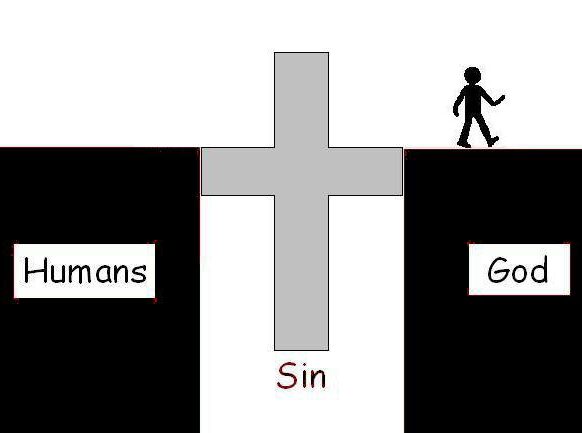

There are many different religions and philosophies in the world. Jesus never pointed people to any of them. He said:
“I am the way and the truth and the life. No-one comes to the Father except through me.” John 14:6
- A strange statement for a humble man to make! Was he arrogant? mad? evil?
- What would you think if your local carpenter came to fix a door and said that about himself?
- How could such a person manage to have had such an impact on history
—being the cause of its division into BC and AD?
Whatever your background, it’s at least worth a look. And, if Jesus is correct in his claims, then believing in him can make all the difference, not only for this life but for all eternity. Let’s begin with a short overview of the gospel.
When we think of religion, one of the big questions that comes to mind is “how can I get to heaven?”. We’ll deal with the matter of the existence of God and the afterlife elsewhere on this site. Here, we want to get right to the heart of the gospel message. Let’s assume for now that God is there, that he is interested in us, and that the Bible is true. If this is the case, humans will spend eternity in either heaven or hell (we’re assuming that the Bible is true, and yes, it does teach that hell exists). Actually, even if this only might be true, it is worth giving it some consideration.
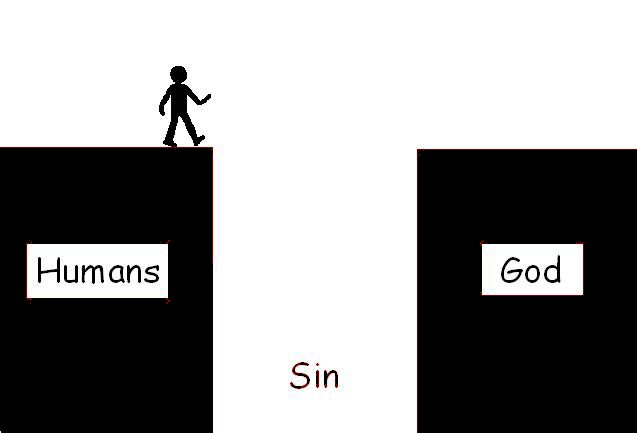
All religions are different, yet most, if not all, agree that God exists.
Another common thread that runs through religions is that humans are alienated from him. Somehow, we need to find our way back. But how can we do this?
Does Religion Get People to Heaven?
One common solution is religion—especially religious ritual. For example, people walk around a church three times, say prayers, meditate, light candles and so on. New rituals, many from the East, are replacing the old, and the trend is for more individualistic rituals, but ritualism in some form is still popular. It certainly seems to make people feel better in themselves.
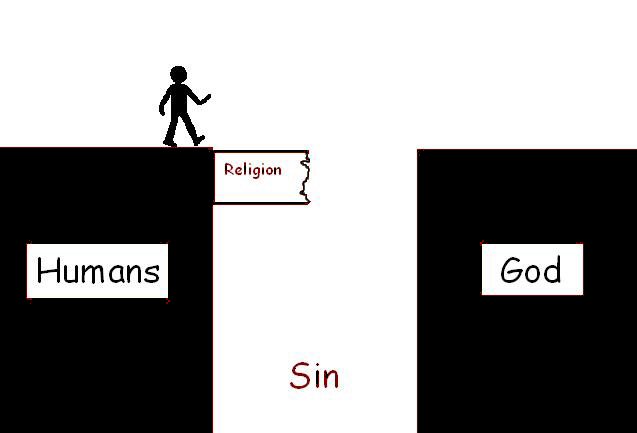
Then there are the folks who don’t bother with ritual or organized religion at all but still identify with a particular religion. This in itself provides them with a degree of security. Maybe they attend church for baptisms, weddings and funerals. They might see church membership as a sort of an insurance policy. They are not sure about God and heaven and all that, but just in case these things are true, they have their membership card.
But is Religion the Answer?
The world already had many religions before Jesus Christ came into the world. If religion was the answer, why did the world need a Saviour?
- It was religious people, the Scribes and the Pharisees, who were the chief opponents of Jesus.
- Even the exceptional Pharisee, Nicodemus, who was friendly and open towards Jesus, wasn’t sent to his legitimate religion for salvation. Jesus told him that he must be born again (we’ll see later what this means).
- He told his disciples to bring the gospel to all nations. They needed the gospel, not their own or any other religion.
- Later on, after Jesus went back to heaven, ritualistic ‘religious’ practices were discouraged in the early church, apart from baptism and the Lord’s Supper (communion)—and there was very little that was ritualistic or ‘magical’ about these at the beginning.
Galatians 4:8 ff Formerly, when you did not know God, you were slaves to those who by nature are not gods. But now that you know God—or rather are known by God—how is it that you are turning back to those weak and miserable principles? Do you wish to be enslaved by them all over again? You are observing special days and months and seasons and years! I fear for you, that somehow I have wasted my efforts on you.
Of course, it would be silly to say that people shouldn’t have regular routines, such as praying, singing hymns and meeting together for worship. It is natural for Christians to express their faith to God and others—but these things do not make you a Christian or get you to heaven. The most that can be said is that they are an expression of your faith, provided they are practiced in a thoughtful and meaningful way.
What About Good Works?
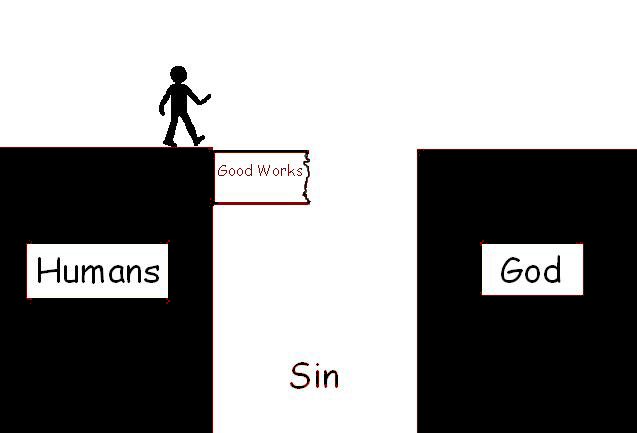
Many will be happy to know that religion isn’t the answer. It’s now trendy to be disillusioned with formal religion—or any kind of religion! Why not just live a good life and do no harm to anyone?
The problem here is that we do harm people, and we offend God. There’s no point in fooling ourselves. We say things we regret, we do things we regret, and we even feel guilty when certain thoughts cross our minds. If we are honest, we don’t even do our best. Anyone who thinks that they never miss the mark is generally regarded as proud and arrogant. And it’s not just what we think or what other people think that matters. Ultimately, God is our judge. We should want to know what his opinion is. The greatest command of all, according to Jesus is to “love the Lord your God with all your heart, all your soul, all your mind and all your strength” (Luke 10:27). I remember growing up wondering why hardly anyone (including myself) even seemed to want to begin to do that. In fact, among my friends, you could barely mention God, apart from using his name as a swear word.
Some people are worse than others, but the Bible says that we all have failed.
Rom 3:10 ff
As it is written: “There is no-one righteous, not even one; there is no-one who understands, no-one who seeks God. All have turned away, they have together become worthless; there is no-one who does good, not even one.“
It’s interesting that when Jesus was encouraging his disciples to pray, he made a passing reference to them being evil, as if it would be no surprise for him to say such a thing.
Matt 7:11
If you, then, though you are evil, know how to give good gifts to your children, how much more will your Father in heaven give good gifts to those who ask him!
Only one link in a chain needs to be broken for it to fail. Those who think that they haven’t failed are guilty of the sin of pride! In fact, Jesus said that there is no-one good except God alone (Luke 18:19). Many of the parables are directed towards those who are good in their own eyes. Of course, we can and do use terms like good and bad in a relative way. A person should aim to be ‘good’. But getting to heaven isn’t a matter of earning brownie points or doing a life-long driving test. If we could get to heaven by being good, there would be no need for a Saviour.
Doesn’t Everyone Just Go to Heaven Anyway?
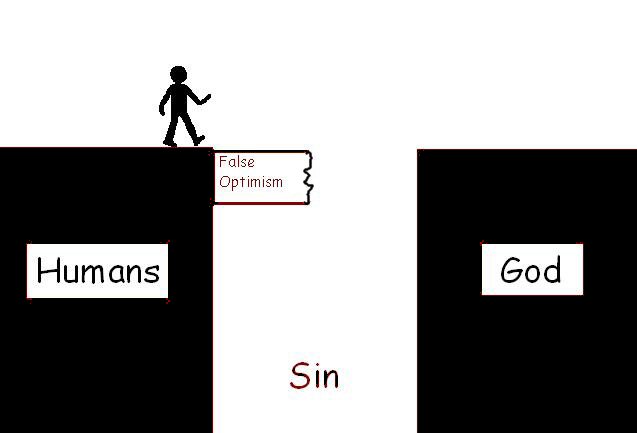
There was a time (not so very long ago) when churches used to scare people into being religious by dangling them over the fires of hell or purgatory. Even when I was a Roman Catholic child in the 1960s and 1970s, we were told that the best we could probably expect was purgatory, which was pretty much the same as hell, except you would eventually get out of it, especially if people prayed for you.
People don’t want that anymore. Now we have a ‘cuddlier’ god. A very popular idea these days is that God is a sort of Santa Clause figure. He might threaten not to bring presents, but in the end, he always caves in—regardless of how bad we are. If there is a purgatory, it’s just some sort of a waiting room where you’re purified.
If the afterlife is some sort of fantasyland that you create in your mind, then put anything you like in it! If God is just a Santa Claus figure, who always brings us our toys in the end, then forget about the danger of hell. Just think of Mickey Mouse greeting you at the gates of heaven. But if you want to believe Jesus, then there is a hell as well as a heaven. Go and have a look at the gospels. You might come across clever people who try to believe the Bible, yet focus on trying to find ways ’round it, but it is there in black and white. There’s no purgatory, but there is a heaven, which appears to be more wonderful than anything we experience on earth, and there’s a hell, which is the exact opposite, whether or not you believe in a literal fire. Surely it’s better to focus on avoiding it rather than trying to wish it away or speculate that it mightn’t be all that bad.
You can, and should, change church teachings on areas such as not eating meat on Friday (something that was never in the Bible in the first place) but you mustn’t remove or disregard the parts of the Bible that you don’t like, given that we’re talking about the word of God here. The existence of hell might cause us problems, but better to live with the puzzles or problems than to try to deny what God has revealed. Strange that you don’t get as many people denying the existence of heaven! It’s the same Jesus who tells us about both!
But is hell only for really wicked people—such as Hitler and Jack the Ripper? Well, who did Jesus come to save? If he came to save us all, then that implies that we are all lost if we don’t believe in him. We all need to be rescued. Yes, some are more wicked than others, but all have sinned. Some of the people on the Titanic might have been better swimmers than others, but none of them had any hope of swimming to the shore. They needed salvation—and some found it. Thankfully, the RMS Carpathia came and rescued them. It didn’t bring them part of the way and ask them to attempt to swim the rest of the way themselves. It brought them all the way. Jesus saves us completely. Of course, they did need to show initiative to get as far as the Carpathia. And we need to show initiative by repenting and reaching out to trust in Jesus.
Hebrews 7:25
Therefore he is able to save completely those who come to God through him, because he always lives to intercede for them.
We Get to Heaven by Repenting and Trusting in Jesus Alone
Jesus was able to assure his followers that he was going to prepare a place for them (John 14:2). He said this, even though he knew their faults and failings. He knew that they’d all desert him and that Peter would deny him. Yet he also knew that they were going to heaven because he was about to lay down his life for them. He was able to tell the repentant thief on the cross that he would be with him in paradise on that very day (Luke 23:43).
But how many other people around the cross were given that promise? The thief repented. He trusted in Jesus.
- He didn’t try to convince himself that he didn’t deserve what he was getting.
- He didn’t compare himself with others and claim that he was not all that bad.
- He didn’t recount the good deeds that he did, hoping that they might outweigh the bad.
- He put himself completely into the hands of Jesus.
- His mind wasn’t on this world but the next.
Someone once said that becoming a Christian is like walking away from two piles of rubbish. One pile is your sins. The other pile is your good deeds. The prophet Isaiah said that our righteous deeds are like filthy rags. (Isaiah 64:6). If a husband bought flowers for his wife every time she discovered him having and affair, would such behaviour appease her?
People sometimes get upset when they are asked to accept that they need a Saviour. “What about all the good I’ve done?” It’s like saving all your money and finding the currency devalued or worthless. But our righteousness is of no value if we think that it buys us a place in heaven. We should do good anyway. But to get to heaven, like the dying thief, we depend on Jesus and him alone for salvation. The apostle Paul knew this. In the book of Philippians (3:4-9) he lists all his credentials and then says that they count for nothing. Like the thief on the cross, he relied on Christ alone for salvation.
Phil 4:7-9
But whatever were gains to me I now consider loss for the sake of Christ. What is more, I consider everything a loss because of the surpassing worth of knowing Christ Jesus my Lord, for whose sake I have lost all things. I consider them garbage, that I may gain Christ and be found in him, not having a righteousness of my own that comes from the law, but that which is through faith in Christ—the righteousness that comes from God on the basis of faith.
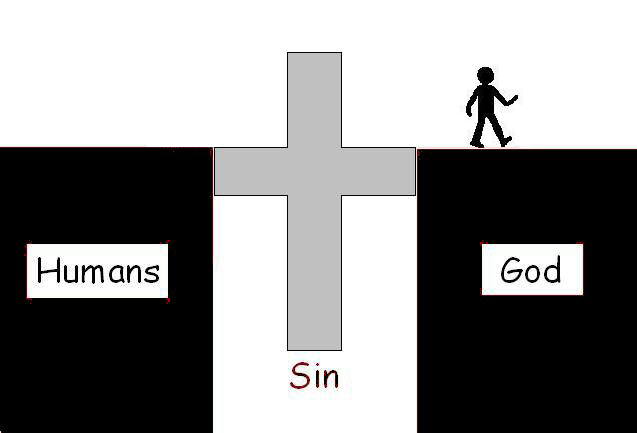
When Do we Cross the Bridge?
Some people believe that you never quite know where you stand in relation to God. You never really cross the bridge until you die. Only then do you find out if you will get to heaven. When you believe, you are forgiven, but then you start sinning again and you’re back to square one! Jesus saved you but you slipped out of his hands through sin. You then start all over again. This sounds to me like a game of snakes and ladders! It suggests that the Saviour doesn’t really save you. He simply gives you instructions or some kind of a head start—allowing you to be in with a running chance. But is this the case? If it were, it would mean that salvation was partly a matter of merit, but it isn’t. Imagine a conversation like this in heaven:
- I got to heaven because I’m such a wonderful person and I was really religious.
- Well, I wasn’t very religious, but I was a pretty good person just the same.
- Myself—I wasn’t even very good, but thankfully I did just about enough to get here.
- It was my study of Eastern religion and Yoga that got me here.
The problem with that is that everyone is basically boasting and giving themselves all the credit or at least some of the credit. The Bible says, “not by works, so that no-one can boast” (Ephesians 2:9).
Those who truly get to heaven will give all the credit to God alone and more specifically to the death of Jesus Christ for them. And if it all depends on God, we are a lot more secure than if it depended on us. I would much prefer a lifeguard to dive in and save me than for someone to shout instructions from the shore! Jesus said:
John 10:27-30
“My sheep listen to my voice; I know them, and they follow me. I give them eternal life, and they shall never perish; no-one can snatch them out of my hand. My Father, who has given them to me, is greater than all; no-one can snatch them out of my Father’s hand”.
It would be a bit strange to give such an assurance if Christians were capable of losing their salvation through their own sin and folly. It would be like an adult taking another family’s child for a walk, the child getting hit by a car and then the adult saying, “it wasn’t my fault—it was your child’s fault”. Well, perhaps humans can be incompetent rather than careless, but God is neither. If he assures me that no-one can snatch me out of his hand—I know that the ‘no-one’ includes me. And if he assures me that I’ve already crossed from death to life, I needn’t worry about where I’m going when I die. The early Christians certainly didn’t!
Jn 5:24
“I tell you the truth, whoever hears my word and believes him who sent me has eternal life and will not be condemned; he has crossed over from death to life.”
2 Timothy 4:2
“Now there is in store for me the crown of righteousness, which the Lord, the righteous Judge, will award to me on that day–and not only to me, but also to all who have longed for his appearing.”
1 John 5:13
“I write these things to you who believe in the name of the Son of God so that you may know that you have eternal life.”
As far as the early disciples were concerned, they had already been saved—and were safe! They were across the bridge, though not yet in heaven. It’s a bit like getting into college. Once you have secured a place, you have got into the college. Your course might not be starting yet, but you know that you are going. There would be little point in looking forward to going to be with Jesus if you weren’t sure whether he was going to welcome you into heaven or cast you into hell. As has been pointed out, there is a hell, but there is also a guaranteed way of escape.
The writer of ‘Amazing Grace’ knew that he had escaped. If you look at the words, here is someone who is certain of heaven because of what God has done for him. He doesn’t wonder if he will make it to heaven—he knows. It’s not ‘if’ but ‘when’.
Amazing grace, how sweet the sound
That saved a wretch like me
I once was lost, but now I'm found
Was blind, but now I see

'Twas grace that taught my heart to fear
And grace my fears relieved
How precious did that grace appear
The hour I first believed
Through many dangers, toils, and snares
We have already come
'Twas grace that brought us safe thus far
And grace will lead us home

When we've been there ten thousand years
Bright shining as the sun
We've no less days to sing God's praise
Than when we've first begun
But Hang On—Does that Mean I Can Go Out and Murder Someone?
Some think that this is a very odd message because it means you are going to heaven regardless of the life you live. Well, this has always seemed a strange objection to me because most non-evangelical people that I’ve met who raised the issue hardly believe in hell in the first place, so they already think that everyone goes to heaven regardless of how you live your life!
Let me ask you a question. If an angel appeared to you tonight and said that God loves you and has a purpose for your life and assured you that you would be in heaven one day, what difference would that make to you? Would you rub your hands together and think of all the sins you’ll be able to commit in the morning?
People generally act with kindness to others not to earn a place in heaven or to avoid hell, but because it is the right thing to do. Being good feels nice! Those who are well brought up learn this. It’s not sufficient to get us to heaven, but we can do good in this world if we are of good character. When you become a Christian and heaven becomes real to you, you are more thankful to God and more highly motivated to love God and love others. Now, morality is more than a sound policy for your wellbeing or the wellbeing of society. There is a much better and deeper reason for doing the right thing. You will fail, just like Peter failed, but generally, you’ll be a better and a happier person.
If Christians sin and don’t feel sorry or if they become careless, God is capable of disciplining them, just as parents discipline their children. Parents who adopt a child can discipline them without threatening to throw them back to the orphanage every time they do something wrong. Of course, if a Christian lived an utterly wicked life, it would call their conversion into question. But Christian’s generally find that questioning their conversion doesn’t help them to be better people. Look to Jesus rather than yourself!
Having said all this, you will find some scary statements in the New Testament, directed to people who might be considering abandoning the Christian faith, or people who are deliberately indulging in sin while thinking that they’re gonna get to heaven anyway. But these were exceptional cases. I even wonder if such people think about spiritual matters at all. In all likelihood, they hung around the Christian community for whatever benefits it could provide them with, but they never really believed any of it.
For the most part, Christians can look forward to heaven. If we believed that it depended on our works, we could never look forward to it, because any godly Christian will know that they will always fall short of the standard. But if you have an appetite to pray, to read God’s word and to love God and others, however feeble your progress, God is at work in your life.
Romans 10:9
“If you declare with your mouth, “Jesus is Lord,” and believe in your heart that God raised him from the dead, you will be saved.”
How do I Become a Christian?
Sometimes, materials explaining the gospel end with a little prayer that the seeker repeats in order to become a Christian. The problem with this is that it can give the impression that there is some sort of magic in the prayer. Yet people sometimes want to know what you actually say or do to become a Christian.
Some also wonder if they have been a Christian all along. Wasn’t I baptised? Don’t I come from a Christian home or a Christian country? If the New Testament teaches us anything, it’s that we have to respond individually to God. That is why we must be born again (John 3:7). You may have seen the John 3:7 sign at a hurling or football match. It was carried by Frank Hogan, a Tipperary man, who settled in Limerick (now he’s in Heaven). People sometimes associate the “born again” term with America, with TV evangelists of some wacky preacher in a cowboy film. Well, the term was in use long before America was discovered. And anyone who has spoken to Frank will know that it would be hard to find someone more Irish. And of course, St. Patrick used the term “born again” in his confession.
The modern focus on the new birth probably started with people like John Wesley in the 18th century, but of course, the concept goes right back to the New Testament—even to the Old Testament, which is why Jesus was surprised that Nicodemus didn’t know about it (John 3:10).
John 3:7
“You should not be surprised at my saying, `You must be born again. ”
People also think this refers to notorious sinners who repent and start afresh. Well, actually it refers to everyone. Jesus said these words to Nicodemus. It would be hard to imagine anyone so far removed from being a “notorious sinner”. Some people believe that you are born again as a baby if you were baptised. But you cannot impose this on a baby or anyone else. Christian parents should teach their children, but at some stage, these children need to personally respond to the Holy Spirit—and so do the parents if they have not already done so. There is no point in trying to create Christians through social engineering. Surely Ireland and Europe should have learned that lesson by now! Only when we respond individually to the gospel can we say that we have come to life spiritually. Actually, you could argue that the new birth enables you to respond. There’s no reason why this new life couldn’t begin in a baby in some cases, even before it’s born (Luke 1:15), but it’s a work of the Holy Spirit. Our role is to ensure that we are alive spiritually, and this is demonstrated by us repenting and believing in Jesus. We generally associate being born again with this, even though the work of the Holy Spirit will begin before we are aware of it.
Someone said, ‘A Christian is not a person who has made a new start in life, but a person who has received a new life to start with.’
If you are already regarded as a nice person, a good citizen, then the outward change won’t be as dramatic, but there is a radical change inside and your destiny is completely changed. The angels in heaven rejoice (Luke 15:10).
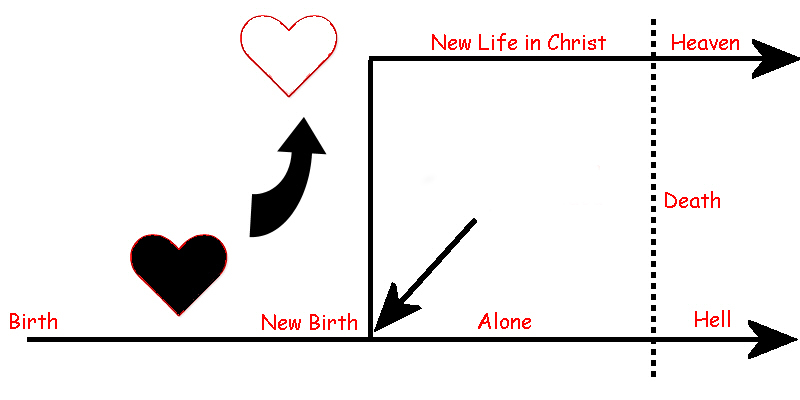
Here are another few texts that speak of the new birth.
John 3:3
In reply Jesus declared, “I tell you the truth, no-one can see the kingdom of God unless he is born again.
2 Corinthians 5:17
Therefore, if anyone is in Christ, he is a new creation; the old has gone, the new has come!
1 Peter 1:23
For you have been born again, not of perishable seed, but of imperishable, through the living and enduring word of God.
In the New Testament, we see people who experienced the new birth and who were personally committed to Christ. In the centuries that followed, whole nations were “Christian”, and nominal Christianity developed. It must have been a great relief to Christians, when the Roman emperor Constantine was converted, but in some respects, it meant that soon, every Tom, Dick, and Harry thought it necessary to profess to become a nominal Christian. History shows that at times, very ungodly people could become priests, bishops, or even Popes. But ultimately Christianity is about your individual relationship with God.
Whatever external Christianity looks like, you can commit yourself personally to Jesus. Perhaps none of us have the sort of commitment to Christ that we see among the best Christians in the New Testament, but a Christian should be committed. So often nowadays, people hop around from belief to belief. You only need to briefly look at the gospels to see that Jesus wants total commitment. That is what a Christian, a disciple of Christ, is meant to be—not someone who happens to be born in a “Christian” country. Geographical locations do not get converted—people do.
Like many other words, the word ‘Christian’ is used in different ways. Sometimes people use it to describe a nice person. So, if someone tells you that you need to become a Christian, it sounds like saying “I’m a nice person and you’re not”! But it’s not about who the nicest person is. The non-Christian could be a lot more pleasant than the Christian. God in his grace has given people of every race and religion the capacity to be nice and to do kind things. Many people might have been surprised that someone like Bob Geldof would have had the impact he has had on world poverty. He doesn’t profess to be a Christian. And it’s perfectly possible for an individual Christian to have all sorts of faults that take a lifetime to overcome. So you might not want to be stuck on a desert island with him! In fact, if you read the biographies of the ‘great’ saints, many of them did have big failings and blind spots. We should not think of the Christian as being ‘better’ than the non-Christian. All sorts of internal and external factors influence our behaviour. We can expect a Christian to improve over time, but progress might be slow. Everyone is different.
You don’t need to say a particular prayer to become a Christian. What you do need is repentance and faith. You need to be willing to turn away from your old life and surrender your life to Christ. For some, this is very dramatic and sudden. For others, the whole process seems more gradual. But it is good to specifically say to God that you are sorry for your sins. You might survey your life, past, present, and even the future and see what you are and what you should be. You tell God that you are sorry. It would be silly to think that you can be perfect, but there should be a willingness to seek God’s help on a day-to-day basis. Then, you ask Jesus to save you. A Christian knows that he or she is going to heaven because Jesus paid for their sins on Calvary. Here are five verses that demonstrate this.
Roman 5:6
You see, at just the right time, when we were still powerless, Christ died for the ungodly.
Eph 2:8,9
For it is by grace you have been saved, through faith–and this not from yourselves, it is the gift of God– not by works, so that no-one can boast. For we are God’s workmanship, created in Christ Jesus to do good works, which God prepared in advance for us to do.
1 Peter 1:18,19
For you know that it was not with perishable things such as silver or gold that you were redeemed from the empty way of life handed down to you from your forefathers, but with the precious blood of Christ, a lamb without blemish or defect.
1 Peter 2:24
He himself bore our sins in his body on the tree, so that we might die to sins and live for righteousness; by his wounds you have been healed.
1 John 1:7
But if we walk in the light, as he is in the light, we have fellowship with one another, and the blood of Jesus, his Son, purifies us from all sin.
People sometimes balk at the term ‘saved’. They think of some eccentric TV evangelist shouting at people that they must be saved. You don’t have to buy into all the silly culture that sometimes surrounds modern evangelicalism. You don’t have to become a clone of other Christians. Not every Christian fits the ‘happy clappy’ Ned Flanders stereotype. In fact, if you study the scriptures, you won’t encounter much of that. There should be a deep joy within us, but Jesus himself was called a man of sorrows, and when you look at the saints in Scripture and history you see all kinds of personalities. You can come as you are. But you do need to be saved. Why do people call him the Saviour if they don’t want him to save them?
What Happens Then?
What happens once you ask Jesus to save you? Again, this varies from person to person. Some people have an overwhelming sense of joy, others might feel a sense of peace or a sense of God’s love. Some might feel very little at all, even though the angels in heaven are rejoicing. Some of us are more emotional than others. But you can be sure that if you do repent and ask Jesus to save you, you will be saved. You might wonder if your repentance or faith is strong enough. God doesn’t demand perfect faith in order to be saved—just faith in a perfect Saviour! Jesus once asked a man if he believed. The man replied, “I do believe; help me overcome my unbelief!” (Mark 9:24). Peter’s faith was very shaky at times. Yet Jesus loved him and used him to build the early church.
There will be days when you are so busy with other things that God becomes very unreal. Think about this:
If we spend sixteen hours a day dealing with tangible things and only five minutes a day dealing with God, is it any wonder that tangible things are 200 times more real to us than God? William R. Inge
You might feel down in the dumps at times. People will test you. You might get annoyed and ‘fly off the handle’. You are still capable of every sin in the book. That is why it’s important to use the resources that God has provided for making you strong. We need to pray every day, read the Bible, find fellowship with other Christians, and be willing to tell others about Jesus. Someone said, ‘if you were arrested for being a Christian, would there be enough evidence to convict you?’ We need to put what we learn into practice if we want to grow and live the supernatural life that we have power to live. Again, all of us are different and find different ways to do these things. But if you look at the New Testament, that is what the early Christians did.
Over time, the full implications of this will become clear to you. The more you think about your future in heaven, the more heavenly-minded you will become, and you will want to love God with all your heart, soul, mind and strength. It will also transform the way you look at others. There is a very obvious bond with other believers and there is a love for all people as all are loved by your Father, all made in his image.
 Hibernia Gospel
[…] wacky. Who knows?😀 I’ve reused some of my earlier material in this blog. An example is the Gospel in a Nutshell page. Looking at it now, it isn’t much of a nutshell, but perhaps the diagram says it all. We […]
LikeLike
[…] cover all that in depth in the Gospel in a Nutshell post. People do argue about the specifics, but the main point is that we are saved by God’s grace. […]
LikeLiked by 1 person
[…] the world to hear a simple presentation of the message of the gospel. I made an attempt at that in Gospel in a Nutshell, but I’m sure that there are much better resources out there. I had the idea back in 2005 […]
LikeLike
[…] my opportunity to present the diagram I use in my Gospel in a Nutshell post. It essentially means that Jesus is our way to reconciliation with God. People try to get to […]
LikeLike
This is very good and organized. I hope that people will be blessed with this!
LikeLiked by 1 person
[…] I created this site last year, a key page was Gospel in a Nutshell. I knew nothing about the Daily Prompt questions back […]
LikeLike