In this series, I’m remembering hymns from different eras of my life, starting with childhood. I was a Roman Catholic up to 1980, when I turned 18. In this post, I’ll look back at hymns that we sang at Mass, back in the 1960s and 70s, and some I was familiar with outside of church. So, here goes. I won’t display the lyrics, but I’ll list them with links to lyrics and to YouTube. Then I’ll add my comments.
The Lord’s My Shepherd
Throughout my life, whichever churches I attended, this has been a key hymn. Following Vatican II, singing Protestant hymns began to gain traction in the Catholic church. This hymn is based on Psalm 23, so because all Christians believe the Bible, it’s easy to see why Catholics have no problem singing it. And of course, the New Testament, particularly John’s gospel, has numerous references to Jesus as our shepherd. One of my favourite verses is the following:
John 10:27-28
My sheep listen to my voice; I know them, and they follow me. I give them eternal life, and they shall never perish; no one will snatch them out of my hand.
Various hymns are based on Psalm 23. Nowadays, the Stuart Townend version is quite popular.
Holy Mary, Mother Mild
I include this one because I remember it very vividly from my first holy communion, way back in 1969. I did like the tune, but I can’t say that I understood the lyrics much. And of course, now, as an evangelical Christian, I don’t agree with directing praise to anyone but God. Catholics emphasize that they don’t worship Mary, they just venerate her. But, looking at this one, it seems very much like worship to me:
Oh! exult, ye Cherubim!
And rejoice, ye Seraphim!
Praise her! Praise her!
Oh! praise our spotless Queen!
Hail Queen of Heaven
This is another hymn about Mary. I include it because we used to sing it so much. Again, I don’t agree with it now. As a Catholic, I don’t really remember ever taking much notice of hymn lyrics, but looking at this one now, one line stands out:
Remind thy Son that He has paid
The price of our iniquity.
Well, I must say that I agree that he paid the price of our iniquity (sin), but I don’t think he needs reminding. God himself loves us, as Jesus points out here:
John 16:26-28
In that day you will ask in my name. I am not saying that I will ask the Father on your behalf. No, the Father himself loves you because you have loved me and have believed that I came from God.
And he did pay the price of our iniquity. A more modern hymn, the Price is Paid, emphasizes this. And I also think of a more traditional Irish hymn, There is a Green Hill Far Away.
There was no other good enough
To pay the price of sin,
He only could unlock the gate
Of heav’n and let us in.
O Sacrament Most Holy
This one was more a part of the sung liturgy than an actual hymn, but again, it’s one that sticks in my mind. I don’t know why you’d sing to a sacrament. Wouldn’t it be much better to address Jesus directly?
OSacramentJesus Most Holy
OSacramentJesus divine,
All praise and all thanksgiving,
Be every moment thine.
Another part of sung liturgy I remember was one we learnt in school as part of a Mass. Lord by your cross and resurrection, you have set us free. You are the Saviour of the world. But I never knew the full implications of this until many years later.
Soul of My Saviour
This is quite an old hymn. The lyrics are a little strange, especially the first verse:
Soul of my Savior, sanctify my breast;
Body of Christ, be thou my saving guest;
Blood of my Savior, bathe me in thy tide;
Wash me with water flowing from his side.
Well, I’ve never been into poetry much. Again, I’d sooner just sing to Jesus than sing to his soul, body, and blood. And I can’t say that I understand what’s meant by sanctify my breast. But I like the last verse:
Hear me, Lord Jesus, listen as I pray;
Lead me from night to never ending day.
Fill all the world with love and grace divine,
And glory, laud, and praise be ever thine.
Holy God We Praise Thy Name
Catholics sing Protestant hymns, but evangelicals don’t generally sing Catholic hymns. I do remember (many years later) someone suggesting that we sing it in an evangelical house meeting. We were all a little concerned 😀. But, when you look at the lyrics, it could easily have been written by an evangelical, though it’s not in simple English.
God of Mercy and Compassion
Again, there is nothing in this one that an evangelical could disagree with. I do wonder if it’s still sung, given how it emphasizes sin and judgement. This is totally biblical, and even if it mightn’t sit well with the Ireland of today, it needs to be emphasized. One memory I have of this one is the line Never will I sin again.
Jesus, Lord, I ask for mercy;
Let me not implore in vain;
All my sins—I now detest them,
Never will I sin again.
I remember, when I was around 12, laughing with my friend at the fact that everyone sings that, and then, they all go out and sin again. Of course, we ourselves did the same thing.
Well, we won’t completely succeed in stopping sinning, but we should commit ourselves to holiness after we repent and trust in Jesus. One of the most well-known gospel stories is the woman caught in adultery, and Jesus telling the Pharisees, whoever is without sin, cast the first stone. But he also spoke to the woman caught in adultery:
John 8:10-11
Jesus straightened up and asked her, “Woman, where are they? Has no one condemned you?” “No one, sir,” she said. “Then neither do I condemn you,” Jesus declared. “Go now and leave your life of sin.”
We don’t hear what happened after. Perhaps she left her sinful lifestyle, but she hardly succeeded in eradicating sin entirely. None of us do, which is why we are so thankful that when we repent and believe in Jesus, we have the assurance of knowing that he has paid for all our sins, past, present, and future. It’s not just an amnesty for past sins.
It brings to mind a hymn I heard in the Irish pop charts way back in 1972; How Great Thou Art
And when I think that God, His Son not sparing
Sent Him to die, I scarce can take it in
That on the cross, my burden gladly bearing
He bled and died to take away my sin
Now Thank We All Our God
When I started attending evangelical churches, I was always pleased to hear hymns that I had sung as a Catholic. I remember learning to sing that hymn in school back in 1974, perhaps with a view to my class singing it at a Mass.
This was actually a German Protestant hymn, written during the Thirty Years’ War, which began as a religious conflict between Protestant and Catholic states within the Holy Roman Empire. Soon, it escalated into a broader conflict. An estimated 4.5 to 8 million soldiers and civilians died from battle, famine, or disease. In 1637, at the height of their misery, the writer, Martin Rinkart, was the only clergyman left in the city who could perform the 40 or 50 necessary burial services daily, one of which was for his wife. So many hymnwriters drew comfort from God in tragic circumstances.
1 Thess 5:16
Rejoice always, pray continually, give thanks in all circumstances; for this is God’s will for you in Christ Jesus.
Faith of Our Fathers
This used to be sung at the All-Ireland hurling finals. Some saw it as a jibe against the British, who tried to discourage, or even stamp out, Catholicism and smaller Protestant sects. I remember some Catholics laughingly remarking that it was a Protestant hymn. It actually was written by a Catholic (a convert from Protestantism), but Protestants used to sing it too, with some adjustments. I think, perhaps, the writer was thinking primarily of the persecutions that went on in the early church. I’ve never really heard it in evangelical circles, even though we do have huge respect for those who died for their faith down the centuries.
After Constantine’s conversion, the church grew substantially, but it was very much the beginning of nominal and tribal, state-sponsored Christianity. It wasn’t long before Christians were the ones doing the persecuting, sometimes persecuting and going to war with other Christians for religious reasons.
After the reformation, independent churches, such as Baptists and Quakers sought to break with politics altogether. I grew up in the south of Ireland, where Catholics and Protestants were quite friendly. But hardly a day went by when you wouldn’t hear of awful shootings and bombings in the north. Sometimes atheists blame such things on religion, but it’s more down to tribal attitudes, which you can find even with rival football teams. I have heard of terrorists who became Christians, but I don’t think you’d find many terrorists who were true Christians. Although, if the other side commits appalling atrocities, it’s easy to see how you could become sympathetic with anyone from your own community who’s fighting back. Thankfully, and hopefully, it’s all over now.
Praise to the Lord, the Almighty
This is one that we sing in evangelical churches, but we did sing it in Mass too. I do remember us trying to figure out what we should sing for the following line:
All ye who hear,
Now to this altar draw near.
Evangelicals believe that we don’t need altars anymore, because Jesus died once for all, so there’s no need for sacrifices. It’s often sung as Now to this temple draw near, or Brothers and sisters draw near. Maybe the original, which was written by a Protestant, didn’t use the word altar, or if it did, perhaps he meant it in a metaphorical sense. Joachim Neander, the writer, gave his life to the Lord at 20, and died of tuberculosis at 30.
We Stand for God
My childhood memory of this one was being at Mass with a friend and not wanting to bother standing up for the last hymn. Then, they started singing We Stand for God 😀. It was written by an Irish Dominican, and it’s really more relevant to Australia and New Zealand. Reference is made to the Southern cross, which features in the last verse, added by John O’Brien, and on the Australian flag. Maybe that bit wasn’t sung in Ireland. I never remember hearing it sung in evangelical circles.
We stand for God! in ages olden
He placed “the Cross” our stars beside;
O may our land, gracious and golden,
Be faithful to the Crucified.

Christ Beside Me
Roman Catholic Jesuit priest James Quinn wrote this one, which is based on a prayer of St. Patrick. It uses the same Scottish folk tune that’s used for Morning Has Broken, recorded by Cat Stevens in 1971 and also by the New Seekers, Judy Collins, Dana, Neil Diamond, Art Garfunkel, Kenny Rogers, Anni-Frid Lyngstad (of Abba), among others. Morning has Broken features in the popular evangelical hymn book, Mission Praise. And the Christmas song, Child in a Manger is based on the same tune. I never heard Christ Beside Me in an evangelical church, but we’d all be fine with the lyrics. It’s a much better tribute to St Patrick than Hail Glorious St Patrick, which, in my opinion, treats him as the patron god of Ireland. I can see how it would work as a poem, or as something you might say when you meet Patrick in heaven, but it’s not appropriate to adore anyone other than God, nor to communicate with those who have moved to their mansions above.
I do remember a few other folk songs being adapted for Mass. One was based on Michael Row the Boat Ashore.
Sweet Heart of Jesus
I heard this one a few years ago on Sounds Sacred, which I listen to every Sunday. It struck a chord with me. I vaguely remember singing it at Mass. It’s a Catholic hymn, which I’ve never heard sung in evangelical churches. There’s nothing much wrong with the lyrics, but I find it a little strange to sing to the heart of Jesus, rather than to Jesus himself. It reminds me a little of holy pictures, where you see a painting of Jesus, with his sacred heart highlighted. This sort of thing has a long and complex history. I never really understood it. Perhaps, in times when people had little access to the New Testament, as we do today, faith was based more on mysticism, alleged apparitions, and speculations. But even back then, I can’t think of any reason why someone couldn’t pray to Jesus directly rather than through statues etc.
Make Me a Channel of Your Peace
This one has a modern feel to it and is based on a prayer of St. Francis, which Maggie Thatcher quoted when she came to office in 1979. This is one of the few Catholic hymns that evangelicals do sing. It features in the Mission Praise hymn book. It was the sort of one that would be sung at school Mass. Speaking of St. Francis, a popular song in Ireland in 1973, when I had my confirmation, was Suffer Little Children, which was recorded at St. Francis Church, Cork. It featured on the Let Me Bring Love album, recorded in 1972. At that stage I was big into pop music and generally despised music from Irish showbands etc., but this is one Irish song that I confess to enjoying.
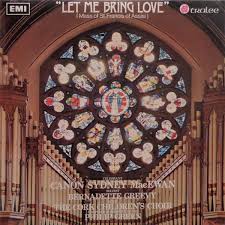
I remember being quite surprised, about 15 years later, that an elderly evangelical man who I was friendly with, had bought the album, even though it was a Mass. He wasn’t an ecumenical type, but he was quite positive about parts of the Mass that were based on Scripture.
Nearer My God to Thee
This is a Protestant hymn based on Jacob’s experience in Genesis 28:10-22. We sung it at Mass quite frequently. It’s often associated with the sinking of the Titanic. The dance band were said to have played it. One line that always puzzled me was:
E’en though it be a cross that raiseth me
So let’s ask Microsoft Copilot 😀.
It’s a poetic way of expressing the idea that even through suffering or hardship (symbolized by the “cross”), one is brought closer to God or raised to a higher spiritual state. The “cross” here signifies burdens, challenges, or trials that one might endure, and “raiseth me” suggests that these difficulties can elevate a person’s faith or spiritual growth.
Well, this is an excellent answer. It brings to mind the following verses:
James 1:2-4
Consider it pure joy, my brothers and sisters, whenever you face trials of many kinds, because you know that the testing of your faith produces perseverance. Let perseverance finish its work so that you may be mature and complete, not lacking anything.
I have heard reference to the Titanic in many sermons over the years, particularly the story of Pastor John Harper, who preached the gospel to other passengers, even in the icy water.
Hail Redeemer King Divine
I added this one a couple of months after I wrote the original post. I thought I had remembered them all, but this one just popped into my head, and I remembered quite a lot of the lyrics. It was written by Patrick Brennan, a redemptorist priest, born in Roscommon on November 16, 1877. The lyrics are excellent, and I would think that any evangelical would be delighted to sing them. The redemptorists specialize in preaching. I remember, one day, in the old Limerick Baptist Church in O’Connell Avenue, I just happened to be working in the building and a redemptorist priest popped in. I think they were having a mission that week in Mount St Alphonsus, Limerick. He mentioned that he read a book by C.H. Spurgeon, a famous Baptist, on preaching. Over the years, nuns often encouraged us in our street work, but priests would generally avoid us. Maybe they just wanted to avoid an argument. But, though I’m not an ecumenical type, I’ve always appreciated it when Catholics encourage us. In more recent years, in Tipperary town, we had a little bookstand in a shopping centre, and again, a Catholic priest spoke a few kind words to us.
Anything Else?
Just to conclude, it’s worth mentioning another few songs I knew from Childhood, and my teens, that touch on spiritual themes.
- Amazing Grace
I don’t remember singing this one at Mass, but it was a hit for Judy Collins in 1970 and for Pipes & Drums & Military Band of the Royal Scots Dragoon Guards in 1972. I got interested in pop music in the Autumn of 1972, but this was definitely one that everyone knew before then. It’s a wonderful hymn that we sing all the time. It even has a modern version now which featured in the film Amazing Grace. But I prefer the older one, which was recorded by Elvis, Rod Stewart, Aretha Frankin, and Johnny Cash among others. Around the same time, there were some chart hits from Jesus Christ Superstar, and there was Day by Day from Godspell, and a few from Joseph and His Amazing Technicolor Dreamcoat. - Abide With Me
This one featured on an album of religious songs that we had at home. It’s undoubtedly one of my all-time favourites, especially as I get older.
Change and decay, all around I see,
O Thou who changest not, Abide with me - My Sweet Lord
I didn’t really become familiar with this one until 1975, when I heard it on the radio during a holiday in Crosshaven, Co. Cork. I was familiar with George Harrison’s 1973 hit, Give Me Love. Both were religious songs. The lord in question wasn’t Jesus but Krishna. George Harrison, like myself, grew up a nominal Roman Catholic. He wasn’t impressed with nominal religion. So he looked East.
I was quite curious about Eastern religion too as a teen. You would see Hare Krishna people around Cork. I even bought a couple of LP records off of them. There was something exotic or magical about it. But I soon realized that Jesus claims to be the exclusive way to God. Other religions might grasp some aspects of truth, such as the existence of God, the need to love him and love others, and the need to plead for mercy. And they might discover ways of enhancing our physical and mental wellbeing. But there is only one Saviour. Yet, I was inspired by how George was so public about his faith. What inspired him to write My Sweet Lord, was Oh Happy Day, which is a Christian song. I used to like reggae music too back in the late 70s. Again, much of it was inspired by gospel music, but it was linked to Rastafarianism rather than Christianity. It’s funny that pop and rock music has its roots in gospel music, but I never really liked Christian pop music, apart from Bob Dylan’s Christian albums. They do say it has improved though 😀. There was even a song back in the 70s called Why Should the Devil Have All the Good Music. - One Day at a Time
This was a big hit in Ireland in the late 70s by Irish country artist, Gloria. It seemed to be in the charts forever. It annoyed me because I was into punk rock at the time, and you’d always get frustrated when an Irish country song came on the radio. But, about a week before I became a Christian in 1980, I was on a bus tour, and someone asked me to sing. What did I choose to sing? It was One Day at a Time 😀. Maybe I was trying to punish myself for being so obsessed with being cool throughout my teens. - Our God Reigns
I associate this with John Paul II’s visit to Ireland in September/October 1979. I travelled up from Cork to Limerick in the middle of the night. I wasn’t really very enthusiastic. I was more excited about a Stranglers concert in the Cork Arcadia a few days later. But one thing I did like about the visit was the young people in Galway singing Our God Reigns, which is based on Isaiah 52. I didn’t think much about the words. The tune was catchy. It reminded me of the chorus of The Jarrow Song by Alan Price. Then, about a year later, I was sitting in the Upper Room, a Pentecostal church in Cork, and they started singing Our God Reigns. I was quite surprised to hear it because I thought it was a Catholic song. It was written by a charismatic man who moved in both Catholic and evangelical circles. - When the Saints Go Marching In
This was always a well-loved song in our home, but I never thought of it as a spiritual song. When Louis Armstrong sang, I want to be in that number, I thought it meant, I wanna be in that song. It means he wants to be among the saints in heaven when the world ends.
Rev 5:11 Then I looked and heard the voice of many angels, numbering thousands upon thousands, and ten thousand times ten thousand. They encircled the throne and the living creatures and the elders.
It’s a traditional black spiritual, originally sung in churches. In fact, you could argue that’s this is where all modern rock and soul music comes from. And some have even argued that aspects of Celtic music was an influence on black spiritual music. It’s a shame that we don’t have anything like that music in any Irish churches. Maybe we’d just feel silly singing it. Getting back to the end times, the wonderful thing is people from every nation will be among the saints who go marching in.
Revelation 7:9
After this I looked, and there before me was a great multitude that no one could count, from every nation, tribe, people and language, standing before the throne and before the Lamb. They were wearing white robes and were holding palm branches in their hands.
In the next post, I’ll reflect on the music I associate with some of the evangelical churches that I attended in the early 80s, following my conversion.
 Hibernia Gospel