I’ve been exploring some of the very modern worship songs as an old guy 😀. But now, I’ve decided to alternate between very modern hymns, old hymns, and in-between hymns, namely the worship songs from the 60s to the 90s that feature in hymnbooks such as Mission Praise. Today it’s the turn of the old hymns.
Today’s song is Thine Be the Glory from 1884, written by Edmond Louis Budry, a Swiss Reformed pastor..
1 Thine be the glory, risen, conqu'ring Son;
endless is the vict'ry Thou o’er death hast won.
Angels in bright raiment rolled the stone away,
kept the folded grave-clothes where Thy body lay.

Refrain:
Thine be the glory, risen, conqu'ring Son;
endless is the vict'ry Thou o’er death hast won.
2 Lo! Jesus meets us, risen from the tomb.
Lovingly He greets us, scatters fear and gloom;
let His church with gladness hymns of triumph sing,
for the Lord now liveth; death hath lost its sting. [Refrain]

3 No more we doubt Thee, glorious Prince of life!!
Life is nought without Thee; aid us in our strife;
make us more than conqu'rors, through Thy deathless love;
bring us safe through Jordan to Thy home above. [Refrain]
It’s certainly among the most popular Easter hymns. I remember hearing about a modern hymnbook changing it to “Yours be the Glory”, but few people like to change the lyrics of old hymns.
In my younger years, two popular modern Easter songs were “He Lives“, and “Because He Lives“. And nowadays, some of the newer worship songs focus on the resurrection. But it’s a great joy to see people of all denominations and persuasions singing the same hymns, and this is one that you could hear anywhere. I don’t remember singing it when I was a Roman Catholic, but I don’t think Catholics would find anything objectionable in it. In fact, many of the hymns that we sung in our Catholic church were Protestant in origin.
I can’t identify a particular line that I like best. It’s all great. But the second verse reminds me of the surprise and joy of the women, such as Mary Magdalene when they met the risen Christ. At that time, the witness of women wasn’t valued, which is an indication of the authenticity of the story. If you were making it all up, you’d probably be better off leaving them out altogether.
And one wonders how the Apostles felt before they met Him. He certainly predicted his death and resurrection, but perhaps they didn’t realize that it would happen in such a tangible and public way. Maybe they wondered if His spirit might just return to heaven. Maybe they even debated among themselves in the way that Christians disagree about the specifics of the second coming. Thomas was quite skeptical when the others met Jesus and passed the information on to him. And then, he himself met the risen Christ:
John 20:28-29
28 Thomas said to him, “My Lord and my God!” 29 Then Jesus told him, “Because you have seen me, you have believed; blessed are those who have not seen and yet have believed.”
Despite his bold declaration of the deity of Jesus, we still know him as “doubting Thomas” 😀.
But at least Thomas is often portrayed in movies. No-one ever played me in a movie, at least no-one yet 😀.
The sequences of events following the resurrection is quite confusing. But that in itself is a good argument for the reality of the resurrection. If the Apostles had just invented it, they would surely have got their story straight. But many people encountered the risen Christ, and the gospel writers researched and reported it from the perspective of various witnesses. Why didn’t the Holy Spirit make it all clearer? Well, it was clear enough for the thousands who believed it in the weeks and months following the resurrection, people who were in a position to check all the facts.
One of my favourite books on the resurrection is The Easter Enigma by John Wenham. He puts together a possible sequence of events. He makes it clear that it’s a possible sequence. He doesn’t claim to know the precise sequence.
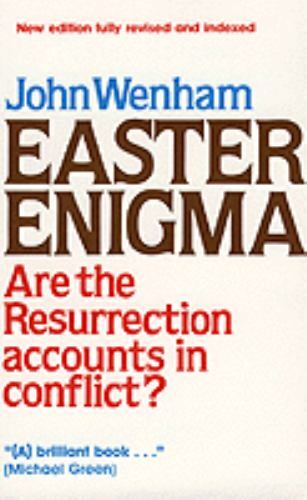
I have read the book a few times. Nowadays, I might just ask Microsoft Copilot:
But if Jesus won and endless victory over death, why do we still die? Jesus’ victory over death is complete, but its full effects unfold in stages — beginning with Him, continuing in us spiritually, and completed in us physically at the general resurrection when Jesus returns.
In the Book of Acts, the first few chapters demonstrate the significance of the resurrection, but the book, written by Luke is a very honest book. You soon see the trials that the disciples encountered through persecution and the conflicts within the church. And if even describes a big fallout between the Apostle Paul and Barnabas. That’s one of the many reasons why I view the Bible as authentic. It simply rings true. And even people who don’t see it as God’s word can treat it as a description of what the early church believed. And here’s how Luke begins the book of Acts
Acts 1:1-5
1 In my former book, Theophilus, I wrote about all that Jesus began to do and to teach 2 until the day he was taken up to heaven, after giving instructions through the Holy Spirit to the apostles he had chosen. 3 After his suffering, he presented himself to them and gave many convincing proofs that he was alive. He appeared to them over a period of forty days and spoke about the kingdom of God. 4 On one occasion, while he was eating with them, he gave them this command: “Do not leave Jerusalem, but wait for the gift my Father promised, which you have heard me speak about. 5 For John baptized with water, but in a few days you will be baptized with the Holy Spirit.”
Anyway, here are some other versions of today’s hymn. Happy Easter!
 Hibernia Gospel