

When I think of teachers, I can consider the following:
- Primary school – Probably my teacher in my final year
- Secondary school – Although metalwork was the subject that I decided to pursue, eventually training to be a metalwork teacher, I would think that my English teacher was the most influential
- Third level – Most were very influential, I can’t single any one of them out
- Third level 2 – This was my Graduate Diploma in Computing – my programming lecturer would have been the most influential
- Theology training – My theology lecturer, who was also a pastor was the most influential. I have a vivid memory of so many of his passing, off-the-cuff remarks
- Church – My elders back in Cork, where I spent the first eight years after my conversion. They were truly exceptional.
To answer the “why”, it’s simply because they were effective, friendly, and enthusiastic.
I’m never at ease with mentioning names on my blog, apart from public names. I wouldn’t like people to write about me 😀. Do unto others as you’d have them do to you.
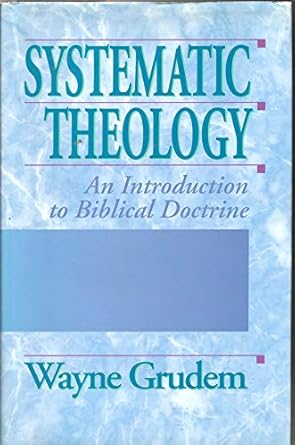
So I’ll choose a public name. I did meet Wayne Grudem in London in 2010. But for the most part, his influence is through reading his Systematic Theology. Before that was published, I used to read Louis Berkoff’s Systematic Theology. Some people in my “reformed” circles were critical of Grudem. He was open to the charismatic movement, he believed in a literal millennium, and he appears to accept that an individual Roman Catholic congregation could be a legitimate evangelical church. But I found his book hugely helpful.
I think that I initially bought the book in 1995. Then, I found some lectures based on the book in 2006. I got the Olive Tree Bible app at one stage where you could purchase online versions of Christian books. You can click all the Bible references and they pop up as you’re reading the book. So, I purchased his Systematic Theology on that. And then, in recent years, I found the second edition of his book on Audible. With Audible, you often get the first month free or you might get a few months at an exceptionally low price. And when you unsubscribe, you can keep the book. I have bought other modern systematic theologies on Audible too. I do enjoy them all, but Grudem’s is still my default.
I should mention other public Christian teachers that have had an impact on me:
- David Pawson: I spent the early years of my evangelical life mixing with Baptists and Pentecostals. I was interested in both, but they differed on their approach to the baptism of the Spirit and spiritual gifts. Most Baptists believed that you were baptised in the Spirit at conversion. Pentecostals believed that it happened after conversion. And Pentecostals believed that the spiritual gifts mentioned in 1 Corinthians continued after the New Testament era.
Baptist opinion varied. Some said these were just to get the church off the ground and that they soon ceased. Others believed that they continued, though they mightn’t go as far as the Pentecostals in practicing them. It’s often believed that there’s much “wishful thinking” regarding miracles, healing, prophecy and speaking in tongues.
David Pawson was an impressive communicator. He was Baptist, but also charismatic/Pentecostal in his outlook. As time went on, he tended to become a little more dogmatic, and he fell out of favour with some, including me, but I still listen to him, maybe out of nostalgia. - Peter Masters: He’s Pastor of the Metropolitan Tabernacle in London. He was decidedly anti-charismatic/Pentecostal. And he was generally critical of modern evangelical movements. I probably was heavily influenced by him throughout the late 1980s and 1990s. I too thought that much of the charismatic scene was a little silly or sinister. I never went quite as far as Peter Masters in dismissing much of modern evangelicalism. Any movement that includes people is going to be somewhat silly or sinister at times.
- RT Kendall: He was Pastor of Westminster Chapel when I lived in London. I used to attend a charismatic fellowship in Bermondsey, but I used to attend Bible Studies on Friday evenings in Westminster Chapel. Westminster Chapel was the church of Martyn Lloyd Jones, who was hugely influential in the modern British reformed movement. Kendall, one of his successors, was controversial because though he was reformed, he was open to modern evangelical practices, believing that the Holy Spirit was at work. He didn’t think it right to distance himself from it simply because some elements were silly or sinister. There’s something about Kendall that resonates with me. I mightn’t be as open as he is about movements such as the “Toronto Blessing”, but I always enjoy listening to him and reading his books. And I’ve met him on several occasions. I was even in his home after a young peoples outing back in 1983.
- Herbert Carson: He was Irish! Because I’m from a Roman Catholic background, I’ve always been interested in how evangelicals differ from Roman Catholics, and what we agree on. Some books from either side are a little hateful, but Herbert Carson wrote several book on Roman Catholicism that were critical, but gracious and fair. And he engaged in debates with Roman Catholics in Ireland. Dawn or Twilight was the first book by him that I read. He was initially an Anglican, but he left that church and became a Baptist in Bangor, Northern Ireland. And he was a big name in the Irish Baptist scene in the 1970s, 1980s, and 1990s. I had the privilege of meeting him several times. He was in my house, and I even drove him to Cork once. I’ve read several of his books, and I’ll probably read them again. I’ll make a little list.
Herbert Carson Books
Many of these are out of print now.
- Farewell to Anglicanism (1969) – Written following his high-profile secession from the Church of Ireland/England due to theological concerns.
- Faith of the Vatican: A Fresh Look at Roman Catholicism (1996) – An evaluation of Roman Catholic dogma from a Reformed perspective.
- Dawn or Twilight? A Study of Contemporary Roman Catholicism (1976) – An earlier look at the changes in the Catholic Church following Vatican II.
- United We Fall: A Study of Current Ecumenical Pressures (1975) – A critique of the movement toward church unification at the expense of doctrine.
- Riots and Religion – A reflection on the social and religious tensions in Ireland during the “Troubles.”
- Facing Suffering: A Christian Response (1978) – Regarded as one of his finest pastoral works, providing a biblical perspective on pain and evil.
- Depression in the Christian Family (1994) – A compassionate look at mental health within a faith context.
- What is a Christian? – A foundational booklet outlining the core of the gospel.
- Sanctification of the Spirit – A published exposition focusing on 1 Peter.
- The Epistles of Paul to the Colossians and Philemon: An Introduction and Commentary (1960) – Part of the Tyndale New Testament Commentary series.
- Hallelujah! (1994) – An exploration of the biblical theme of praise and worship.
- The Christian and the State – A study on the believer’s relationship to civil authority.
- The Christian and the World – Focused on the doctrine of worldliness and Christian living.
- Spiritual Gifts for Today – An exploration of the New Testament spiritual gifts and whether we should practice them today
- Render Unto Caesar – A study of the Christian relationship to the state
And there are many other evangelicals who have influenced me over the years. They’re generally reformed in their theology, but they don’t necessarily agree with each other about everything. And that’s good. I wouldn’t want to be part of a little sect or cult who wants everyone’s opinion tightly aligned to the “leader”. Here are some examples:
There’s a lot of more recent names that I keep hearing, but I’m sort of stuck in my past. I should include my name, but I’m not famous, and I’m very dopey, but I’m a big influence on me 😀.
Anyway, I thought it was a little too obvious to mention Jesus Himself. But here are a few hymns about Him:
 Hibernia Gospel