In this series, I take a brief glance at some of the very modern worship songs. I remember back in the 1990’s, I always sneered at new songs 😃. I’d see them on BBC’s Songs of Praise. You’d have nice old hymns sung in church, and then they’d show some conference with a whole bunch of “happy clappy” charismatic evangelicals singing a new upbeat song. I tended to see the “happy clappy” crowd as superficial – a mere fun club. It’s odd because they were evangelical like I was. And the people singing in old Anglican churches might not have been. But why was I so judgmental? How do I know what’s going on in people’s hearts and minds?
So nowadays, I cherish all Christian music. Today’s hymn is Waymaker. Nigerian gospel singer Osinachi Kalu Okoro Egbu, known as Sinach, composed the song in 2015.
You can view the lyrics at the Passion Music site.
I often wonder what worship songs are sung around the world. It’s nice to think that they don’t all originate in English-speaking countries. Christianity began in the middle east, and it spread around the world. Countries such as the USA and the UK are influential in Christian terms, but they’re influential in all sorts of ways. For example, here in Ireland, I grew up watching British and American TV shows. I followed British football teams, and the music I listened to was generally British or American. But just as we shouldn’t see movies or music as a purely Western thing, we shouldn’t see Christianity, as a purely Western thing. It had already spread far and wide before it got anywhere near the West. And nowadays, it’s growing throughout the world – more than it’s growing in the West. Let’s ask Microsoft Copilot for 10 countries that are seeing rapid growth:
- Nepal
- China
- India
- Nigeria
- Kenya
- Ethiopia
- Brazil
- Philippines
- Indonesia
- South Korea
My hope is that wherever it grows, it would be culturally in tune with that country rather than seem like a little pocket of America or whatever. Having said that, I never liked Irish culture being rammed down my throat. I do like a few Irish hymns and rock groups, but I like to be free to choose what I listen to. That doesn’t make me any less Irish. And it’s probably the same in other countries.
But, it’s nice to sing an African hymn – and we sing it regularly in the church that I attend.
Lyrically, it’s quite simple, but I see nothing wrong with that. Some of the older hymns are quite rich theologically, but when you’re singing them, it’s hard to take it all in. But I think that there’s a place for all kinds of hymns.
The Waymaker chorus lists four terms related to Jesus:
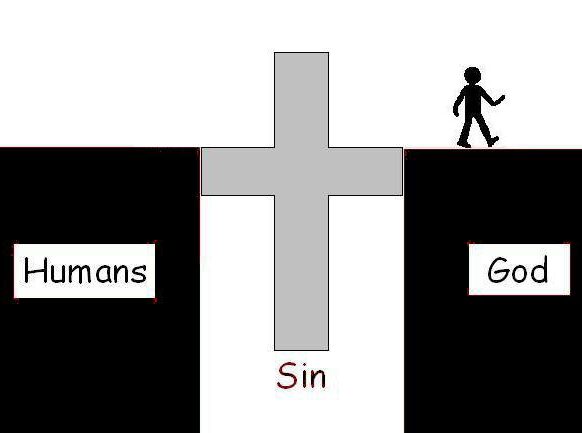
Waymaker
Here’s my opportunity to present the diagram I use in my Gospel in a Nutshell post. It essentially means that Jesus is our way to reconciliation with God. People try to get to God through knowledge, religion, good works and so on, but we need a Saviour. And when we believe, we are saved. We will grow in knowledge, go to church, do good works, but we shouldn’t see these as a means of earning merit with God. Jesus is our waymaker.

1 Timothy 2:5
For there is one God and one mediator between God and mankind, the man Christ Jesus
Miracle Worker
The Bible isn’t full of miracles. At various stages throughout human history God did allow people to perform miracles with served to authenticate new revelation. For example, the early books of the Old Testament are associated with the miracles of the Exodus period, such as the crossing of the Red Sea. Some miracles are associated with the later prophets, such as Elijah. For hundreds of years before Jesus was born, there’s no record of any miracles. Then, what made people notice Jesus wasn’t only his teaching and holiness but his miracles. Peter referred to these on the day of Pentecost.
Acts 2:22
‘Fellow Israelites, listen to this: Jesus of Nazareth was a man accredited by God to you by miracles, wonders and signs, which God did among you through him, as you yourselves know.’
He later refers to the miracle of the resurrection:
Acts 2:32
“God has raised this Jesus to life, and we are all witnesses of it.”
After Jesus ascended into heaven, various miracles were done by the apostles. In fact, they were a sign that someone was an apostle. Paul mentions this to the Corinthians:
2 Corinthians 12:12
Paul writes: “The signs of a true apostle were performed among you with utmost patience, with signs and wonders and mighty works.”
What happened after these initial miracles? Opinions differ. Some people believe that miracles continued to some extent and that they even continue to this day. Others believe that God gave a cluster of miracles to authenticate Jesus and the true apostles. Then, once the church was established, there was no need for miracles. The gospel spread and the Holy Spirit worked in people’s hearts. And today, I don’t need to witness the resurrection of Jesus or any other miracles. I find the historical evidence sufficiently convincing. I am happy to accept all the miracles of the Bible, even though you do get folks, even religious ministers, who doubt them.
A key verse here is from the parable of the rich man and Lazarus in Like 16. The rich man, who is in hell, asks Abraham to send Lazarus back to earth to warn his brothers about hell. He thinks that they’ll believe if someone rises from the dead. But this is Abraham’s answer:
Luke 16:31
31 “He said to him, ‘If they do not listen to Moses and the Prophets, they will not be convinced even if someone rises from the dead.’”
So if someone has no appetite to believe, nothing will convince them. But if their hearts are open, they will listen to God’s word. We shouldn’t think that we need miracles, though as I said, on rare occasions God did use them. And nowadays, it’s not just Moses and the Prophets (the Old Testament) but we have the New Testament to present to people.
But the term miracle is also used in a secondary sense. We might look at how God has worked in our hearts and minds, and it feels like a miracle. Even non-believers often use the word “miracle” in a looser sense – like Ireland beating Italy in a football game 😃.
Promise Keeper
The New Testament doesn’t directly call Jesus a promise keeper. But in Jesus, you see the Old Testament promises of a messiah being fulfilled. He predicts his own death and resurrection, and he fulfills it. He assures his disciples that he is going to prepare a place for them. And he promises to be with them always.
Matthew 28:20
“And surely I am with you always, to the very end of the age.”
If someone told me that they’ll die and rise again in three days, and they did just that, I would happily believe that they’ll keep all their other promises. And millions have felt the presence of Jesus, even if he is not with us physically. It’s often said that the Holy Spirit mediates the presence of Jesus.
Light in the Darkness
One of my favourite verses is the following:
John 8:12
“When Jesus spoke again to the people, he said, ‘I am the light of the world. Whoever follows me will never walk in darkness, but will have the light of life.’”
Back in my teens, when I was searching and trying to decide which religion or denomination was the right one, evangelical Christians told me that they follow a person rather than a religion. I’ve been in various churches throughout my life, and I’ve been interested in different movements, but ultimately, it’s about simply following Jesus, the light of the world.
In the Waymaker verses, she sings about Jesus moving in our midst. And he is with us.
Matthew 18:20
‘For where two or three gather in my name, there am I with them.’
She sings about how Jesus is working in this place, touching every heart, healing every heart, turning lives around and mending every heart. And she sings that even when she doesn’t see it, He’s working and that He never stops working.
Do we sing any other African hymns? One that we sung in Tipperary a few times was “We Are Marching”. The song comes from South Africa, originally composed in Zulu as Siyahamba ekukhanyeni kwenkhos’ (“We are marching in the light of God”).
I would like to get acquainted with hymns from different regions. The funny thing is, there are thousands from English speaking countries that I want to get to know too. But maybe when I pray for a different country every day, I could see if I can find a hymn from that country.
For example, if I’m praying for Egypt, I might find this one:
 Hibernia Gospel