This is a follow-on from Part 1 of this series. You should see this as a little like a child’s school project 😀. If you really want to know about all these people, use Google and find better resources, or click the links that I’ve added under each name. I just enjoyed doing a little research, and I like evangelicals to take a greater interest in history. We tend to want to focus on the New Testament rather than tradition, and we tend to dismiss those who aren’t quite as doctrinally correct as we are. However, many great men and women have contributed to the church and to society over the years, and it’s nice to reflect on their contributions.
Some of these folks come from Northern Ireland rather than Republic of Ireland. I hope no-one thinks that they don’t count 😀. Ireland wasn’t partitioned at that time, and if you are keen for Ireland to be united, you need to welcome Ulster protestants into the new republic rather than send them back to Scotland. Another thing to bear in mind is that some famous Irish republican names were protestants. Examples include Theobald Wolfe Tone, Robert Emmet, Erskine Childers, Charles Stewart Parnell, and Lord Edward Fitzgerald.
I’ve even heard Sinn Fein’s Gerry Adams say that he was a bit Protestant in his thinking during an interview on Gay Byrne’s The Meaning of Life, although, he sounded more like a modernist/liberal than an evangelical. So, I won’t be listing him here 😀. In fact, I am sticking to people of bygone eras. Anyway, let’s begin in the South, in my own hometown, Cork and St. Finn Barre’s cathedral.
1. John Gregg (1798-1878)
- John Gregg was born in Ennis County Clare in 1798.
- His son, Robert, and grandson, John, both became Archbishops of Armagh.
- He became a clergyman in 1826 after being converted as a result of a sermon by Benjamin Mathias at Bethesda Chapel in Dorset Street, Dublin.
- He was known for his eloquent preaching and evangelical zeal. In 1835, Trinity Church in Lower Gardiner Street, Dublin was built specifically for his ministry. It held congregations of up to 2,000. Some other clergy disapproved of him, as often happens with zealous evangelical preachers, such as John Wesley.
- He preached in every county in Ireland.
- William Armstrong Russell, mentioned in Part 1 of this series, was converted under his ministry.
- He was fluent in Irish and used it to preach to Roman Catholic congregations across Ireland and even in Liverpool and London.
- His sermons were often extemporaneous and deeply moving, attracting large crowds—including students from Trinity College.
- He became Bishop of Cork in 1862 and oversaw the construction of Saint Fin Barre’s Cathedral, a neo-Gothic masterpiece designed by William Burges, costing nearly £100,000. It is built near the site of Saint Fin Barre’s first monastery in Cork in the 7th Century. He put the top stones of the spire in place, six weeks before he passed away in 1878.
At a personal level, the last time I visited Saint Fin Barre’s cathedral was for a visit by Hans Kung back in 1985. He wasn’t an evangelical Christian. He was a Roman Catholic, but he questioned some key doctrines such as papal infallibility, so many found his views interesting. Saint Fin Barre’s can hardly be described as an evangelical church nowadays, but that might change in the future. As with the Church of England, the Church of Ireland includes high church, liberal and evangelical elements.
Dictionary of National Biography
How Trinity Church died and found new life, as a church, in inner city Dublin
2. C.S. Lewis (1762-1839)
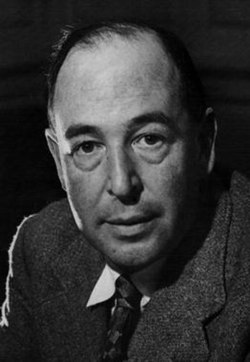
- Clive Staples Lewis (C.S. Lewis) was born in Belfast in 1898.
- He is best known for the children’s series of books (and films) The Chronicles of Narnia.
- He also wrote many books for adults, including Mere Christianity, Surprised by Joy, and The Screwtape Letters.
- He was a professor of English literature at Oxford University for nearly 30 years, then moved to Cambridge as Chair of Medieval and Renaissance Literature. In Oxford, he was a close friend of J.R. Tolkien, author of Lord of the Rings.
- In World War I, he was wounded in the Battle of Arras in 1918.
- He had been an ardent atheist, but he converted to Christianity in 1931.
- He wouldn’t be regarded as an evangelical in the strictest sense of the word, though his writings have been embraced by evangelicals. He did have some peculiar views, which most evangelicals wouldn’t agree with. But in terms of apologetics, he was hugely influential at a time when many evangelicals were prone to be a little suspicious of academics. But nowadays some of the most influential and respected New Testament scholars and theologians are evangelicals.
- He died on November 22, 1963, the same day as John F Kennedy and Aldous Huxley.
- In 2013, Lewis was commemorated with a memorial in Poets’ Corner at Westminster Abbey, a rare honour for a modern writer.
- The 1993 movie, Shadowlands explores Lewis’s late-in-life romance with American poet Joy Davidman and the emotional impact of her death from cancer.
- Another film on Lewis is The Most Reluctant Convert: The Untold Story of C.S. Lewis (2021).
C.S. Lewis Institute
9 Things You Should Know About C. S. Lewis
C.S. Lewis – Reflections on the Psalms (Audiobook)
3. Francis Makemie (1658–1708)
- He is known as the father of American Presbyterianism. He was born in Donegal in 1658.
- He studied at the University of Glasgow, where he underwent a religious conversion.
- He became a Presbyterian minister and was sent to America in 1683 at the request of Col. William Stevens, an Episcopalian from Maryland.
- He founded the Rehobeth Presbyterian Church, considered the oldest Presbyterian church in America.
- He preached across Virginia, Maryland, the Carolinas, and even Barbados.
- He was arrested in 1707 for preaching without a license under British law, but was acquitted, helping establish religious tolerance for dissenters in the colonies.
- He was instrumental in forming the first American presbytery in 1706, uniting scattered churches across several colonies.
- A statue built in his honour in 1918 in Philadelphia, included the following text:
A devoted and able preacher of the gospel, a Christian gentleman, an Enterprising man of affairs, a public-spirited citizen, a distinguished advocate of religious liberty.
Francis Makemie Society
Ulster History Circle
The Life of Francis Makemie | Tuesday Night Lecture Series 2023
4. Joseph Peacock (1835-1916)
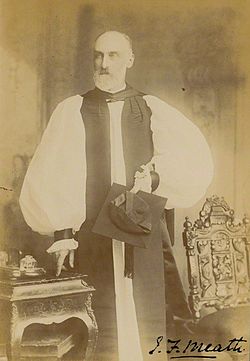
- Joseph Ferguson Peacocke was born in Abbeyleix, Queen’s County (now County Laois) on 5 November 1835.
- Peacocke was firmly aligned with the evangelical wing of the Church of Ireland and was a strong advocate for foreign missions, especially through the Church Missionary Society.
- He studied at Trinity College Dublin and later became a senior moderator in history and English literature.
- From 1861 to 1863, he served as secretary to the Hibernian Church Missionary Society, reflecting his deep commitment to evangelical outreach.
- He became a canon of St Patrick’s Cathedral and briefly held the position of professor of pastoral theology at Trinity College in 1894.
- He was elected Bishop of Meath in 1894, and he was appointed Archbishop of Dublin, overseeing the united dioceses of Dublin, Glendalough, and Kildare until his retirement in 1915.
- In 1908 he acted as a mediator during the carters’ strike in Dublin, working alongside Catholic Archbishop William Walsh to help resolve the conflict peacefully. However, generally he was known for shunning the spotlight and avoiding overt political involvement, preferring to focus on pastoral care and spiritual leadership.
5. Elise Sandes (1851-1934)

- Elizabeth Anne “Elise” Sandes was born on 19 February 1851 into a well-established Anglo-Irish family with military ties.
- Her evangelical fervour was ignited after attending a revival meeting in Bray, County Wicklow, around age 10.
- Moved by the vulnerability of young soldiers stationed in Ireland, she began Bible classes and informal gatherings at her home in Tralee, county Kerry.
- Her first official home opened in Kings Street (now MacCurtain Street), Cork in 1877, offering a wholesome alternative to pubs and brothels for soldiers seeking recreation. The homes were alcohol-free, with reading rooms, tea rooms, and a nurturing atmosphere. Soldiers affectionately called her “Mother” Sandes.
- By 1913, there were 31 homes—22 in Ireland and others in British India, including Rawalpindi, Quetta, and Murree.
- During the Boer War (1899–1902), Sandes Homes were set up in British army camps in South Africa, including canvas tent home.
- Elise Sandes died in August 1934 and was one of only two civilian women ever buried with full military honours, the other being her successor, Eva Maguire.
- The Sandes Homes continued into the late 20th century and some still operate today, maintaining her vision of Christian care and moral support for soldiers.
Great Women: Elise Sandes
Elise Sandes facts for kids
6. W.P. Nicholson (1876-1959)
- William Patteson Nicholson was born on 3 April 1876 in Cottown near Bangor, Northern Ireland.
- As a teenager, he spent several years working on cargo ships, traveling to places like South Africa, where he witnessed hardship and death—experiences that shaped his later urgency in preaching.
- After years of rebellion, Nicholson had a dramatic spiritual awakening on 22 May 1899, which marked the beginning of his evangelical journey.
- He studied at the Bible Training Institute in Glasgow, influenced by revivalist movements and the teachings of Dwight L. Moody.
- Nicholson was known for his direct, humorous, and confrontational sermons, often using working-class language to connect with ordinary people. He didn’t shy away from calling out sin.
- His preaching at Belfast’s Harland & Wolff shipyard led to such widespread repentance that workers returned stolen tools in droves—so many that a “Nicholson shed” was built to store them.
- Though largely interdenominational, Nicholson was ordained by the United Presbyterian Church in Carlisle, Pennsylvania, to support his ministry credentials.
- He preached in Australia, America, and across the UK, often partnering with revival movements and drawing massive crowds.
- In autumn 1959, while returning from America to retire in his hometown of Bangor, Nicholson suffered a heart attack aboard ship. The vessel made an emergency stop, and he was put ashore in Cork, where he was admitted to Victoria Hospital.
Victoria Hospital, Cork
On a personal note, I was surprised to hear that W.P. Nicholson passed away in Cork, my own hometown. It was still known as the Victoria hospital up to 1988, when it was amalgamated with the South Infirmary hospital nearby. I remember visiting people there back around 1982. And I remember meeting an elderly man in Belfast in the 1990s who had heard Nicholson speak in his younger years. And someone once give me a cassette tape of one of his sermons. You can find his sermons online at Sermon Index. He had a very interesting, even humorous style. His influence was evident even right up to the late 20th Century.
12 February 1922: The Nicholson Revival
The Revival Library
Nicholson. Ulster’s Unique Evangelist. 2007
7. Thomas Walsh (1730-1758)

- Thomas Walsh was born in Ballylin, near Limerick in 1730.
- He came from a Roman Catholic background and was deeply religious from a young age.
- At the age of 19, after hearing a Methodist preacher on St. Patrick’s Day in Limerick, he experienced a profound spiritual awakening.
- Walsh was fluent in Irish, English, Latin, Greek, and Hebrew—an extraordinary feat for a self-taught preacher.
- He became one of Wesley’s closest collaborators in Ireland and England, often preaching alongside him to large crowds.
- His sermons were long, loud, and emotionally charged—often delivered in open-air settings like mountains, highways, and meadows. Wesley said he had never known a preacher who converted so many people in so few years
- Walsh was frequently attacked by mobs and had to flee for his life. Despite this, he continued preaching with courage and conviction.
- Wesley entrusted him with overseeing Methodist work in Dublin, Cork, Limerick, and Belfast.
- At the age of 28, after just nine years as a Christian, Walsh died from overwork and illness, having “literally worn out his body in abundant labours”
Thomas Walsh of Limerick
Conversion of Thomas Walsh
8. Cecil Frances (Fanny) Alexander (1818–95)

- She was born Cecil Frances Humphreys on Eccles Street, Dublin, the second daughter in a family of seven children.
- She started writing poetry at age 9.
- Her religious writing was shaped by the Oxford Movement, especially through her connection with John Keble, who edited her work. The Oxford Movement couldn’t really be described as evangelical. In fact, it was high church. Yet, you could mix in high church circles and still hold an evangelical outlook; a personal conversion experience, a dependence on Jesus rather than your own works for salvation, a love for God’s word, and a desire to spread the gospel. She wrote one of the greatest evangelical hymns, among many others. Examples of her hymns include the following:
- All Things Bright and Beautiful
- There is a Green Hill Far Away
- Once in Royal David’s City
- Her hymn book, Hymns for Little Children (1848) became widely popular, reaching nearly 100 editions by the end of the 19th century.
- Her husband, William Alexander, later became Bishop of Derry and Raphoe, and eventually Archbishop of Armagh.
- She helped found the Derry and Raphoe Diocesan Institution for the Education of the Deaf and Dumb in Strabane.
- She passed away at the Bishop’s Palace in Derry in 1895 and was buried in the city cemetery. Her husband published a posthumous collection of her poems in 1896
On a personal note, though I view evangelical churches as more theologically correct, it’s clear that people in other branches of Christendom can come to a true and living faith in the Lord Jesus Christ without being explicitly “evangelical”. I would regard her hymn “There is a Green Hill Far Away” as one of the most explicitly evangelical hymns that I have ever heard. We are saved by faith in the Lord Jesus Christ, and that faith inspires us to live for Christ.
5 O dearly, dearly has He loved,
and we must love Him too,
and trust in His redeeming blood,
and try His works to do.
Once in Royal David’s City
Singing the Faith with Mrs. Alexander
Commemoration | Cecil Frances Alexander (October 12) | Hymn-writer and Teacher of the Faith
9. Benjamin Williams Mathias (1772–1841)

- Benjamin Williams Mathias was born on 12 November 1772 into a Presbyterian family, though he later became a Church of Ireland minister.
- He studied at Trinity college from 1791 to 1796, earning a B.A. and later an M.A. in 1799.
- He began his ministry as a curate in Drumgooland, County Down, under Rev. Tobias Tighe. From 1805 to 1835, he served as chaplain of Bethesda Chapel in Dublin, a hub for evangelical activity.
- In 1806, he founded the Dublin Bible Society, which later became the Hibernian Bible Society.
- Mathias was a key figure in the evangelical movement within the Church of Ireland, promoting Scripture reading and moral reform.
- If his name sounds familiar, I mentioned earlier in this article that John Gregg was converted as a result of a sermon by Benjamin Mathias at Bethesda Chapel in Dorset Street, Dublin.
- He helped establish the Hibernian Church Missionary Society in 1814 to support overseas evangelism.
- Mathias passed away on 30 May 1841 in Dublin and was buried at Mount Jerome Cemetery.
10. Edward Nangle (1799-1883)

- Edward Nangle came from a family with deep Roman Catholic roots but was raised Protestant because of his mother’s faith.
- He was ordained deacon in the Church of Ireland by Bishop Thomas O’Beirne and briefly served in Athboy, Monkstown, and Arva. In Arva, he was heavily influenced by local Primitive Methodists and by evangelical preacher, Rev William Krause, who later preached at Bethesda Chapel in Dublin. Around this time, he had a personal conversion experience, which led him to his missionary work.
- In 1834, on Achill Island, County Mayo, he established a mission aimed at reaching Irish-speaking Catholics. Four schools were established for over 400 children, and a printing press was set up for the Achill Missionary Herald and for printing literature in the Irish language. Evangelical Christians believe in the importance of a personal faith in the Lord Jesus Christ. Many Roman Catholics, Protestants, and perhaps even evangelicals might not have reached this point. People generally follow the beliefs of those around them. Some never question or believe “in their own right”. So, while some might see such work such as Nangles as “proselytising”, with all the trouble that this brings, I’m sure that Nangle would have seen it as pointing people to the Saviour and encouraging personal faith.
- Nangle believed the Gospel should be preached in Irish and translated Church of Ireland texts into the native language.
- His mission led to the construction of schools, a pier, roads, and even a courthouse—transforming the island’s landscape.
- His efforts were seen by many as aggressive proselytism, especially during the Famine, when food aid was linked to religious conversion. This is always a difficulty. For example, if you start a mission in an impoverished area anywhere in the world, you’ll probably naturally want to help meet people’s physical needs as well as their spiritual needs. So, those not attending the church/mission will be envious of those who do. Perhaps the answer is to distribute aid through a secular charity, but in crisis situations, it isn’t always easy to figure all this out.
- Nangle lost his wife Elizabeth and several of their eleven children during his ministry on Achill Island. It’s likely that this was because of poor living conditions and limited medical care.
Achill Island, Ireland
Edward Nangle and the Achill Mission Colony by Patricia Byrne
Edward Nangle, the Achill missionary and a new book
 Hibernia Gospel
Dear Hibernia
I can’t stop praising you for your command on pen.
Thank you for liking my post ‘Potion’ 🙏
LikeLiked by 1 person
[…] Ten Influential Irish Evangelical Christians: Part 2 […]
LikeLike
[…] Ten Influential Irish Evangelical Christians: Part 2 […]
LikeLike