In January 1982, I went to my first concert since I became a Christian. U2 were playing in the City Hall, and a friend persuaded me to go along. They opened with Gloria, which was one of my favourites.
I felt a little strange being back in the ‘worldly’ concert scene. I also felt a bit old, even though I was only 19, going on 20. A few years earlier, I’d always be one of the youngest guys in the Arcadia 😀. Now I was among 16-year-olds.
They had played at Greenbelt the year before, which was a Christian rock festival. I had grown out of rock music a little bit at that stage, though I maintained a more distant relationship with it over the years. I even bought Achtung Baby in 1993. Maybe it was a midlife crisis 😀. And I like some of their recent stuff, such as Magnificent. Anyway, onto the hymns.
He Poured in the Oil and the Wine
Although I was a member of Cork Baptist Church, I mainly hung around with Pentecostals and charismatics at that stage. What’s the difference between Pentecostals and charismatics? Pentecostals were more traditional, a little like Baptist churches, but more lively and slightly different doctrinally. Charismatics tended to be part of a new movement. They didn’t generally have buildings or Pastors. Some of them emerged from the Catholic charismatic movement, but it was very different really. Someone once visited a Catholic charismatic meeting and witnessed everyone going out for a smoke at the end of the meeting. You wouldn’t see that in evangelical charismatic groups 😀. But the main differences were theological.
I went to Dublin with a group to the fellowship in Middle Abbey Street above the Christian Bookshop. Arthur Williams from Stauros was speaking. We did some outreach near what would later become Stephens Green Shopping Centre. I remember some peculiar looking punk rockers hanging around with makeup etc. When I was into punk, I had a slightly punky hairstyle, but I didn’t really dress as one.
We sung He Poured in the Oil and the Wine in the Middle Abbey Street fellowship. This was a new hymn to me at that time, but I never heard it again. It’s an old-style Pentecostal hymn, based on the story of the good Samaritan.
Easter at Kilmoganny
I heard about a little church weekend at a farm in Kilmoganny, Co. Kilkenny, so three of us drove up from Cork. It mainly featured a group from Limerick, who used to meet in the Red Cross hall in Cecil St. It eventually became two fellowships, Abundant Life and Door of Hope. I think they were influenced by what is now called, the British New Church Movement, a charismatic group who produced much great music in the early 1980s. They used to run the Dales and Downs Bible weeks. Like any new movement, it had its extreme side. There was a big push to get charismatics out of mainstream churches and to form New Testament churches. The Radical Christian was a popular book at the time as was the Restoration magazine. And you’d hear stories about the leadership being a bit controlling. But personally speaking, I never encountered anything disturbing in the movement. And it evolved as time went on, and many of the mainline evangelical churches in Ireland and the UK originated in the movement.
The three songs I remember most from that weekend are the following:
Your Love is to Me Like an Ever-flowing Stream. We sang it much faster 😀.
This one was based on 1 Peter 2:9
But you are a chosen people, a royal priesthood, a holy nation, God’s special possession, that you may declare the praises of him who called you out of darkness into his wonderful light.
This one was based on Psalm 45:1-2
My heart is stirred by a noble theme
as I recite my verses for the king;
On Easter Sunday, we drove down to Tramore, Co. Waterford for baptisms in the sea. My own church (Cork Baptist) had a tank in the church building, but most of the new fellowships baptized people outdoors. This was my first time visiting Tramore – lovely place. Later, in the summer of 82, I went back there as part of a Baptist Youth Evangelism (BYE) team. That weekend, a couple of us went along to the Church of Ireland cathedral in Waterford out of curiosity. Of course, it wasn’t evangelical, but I did hear one of my favourite hymns for the first time; Come Down O Love Divine.
Throughout that year, I was big into teaching tapes, especially from David Pawson, a charismatic Baptist who ministered at Guildford. His teaching sat well with me because I was a Baptist, who was interested in the charismatic scene. Many of the Baptists at the time (and myself after a few years) were broadly open to some aspects of the charismatic movement but were a little hesitant because a lot of it seemed like wishful thinking. Were any people really miraculously healed? When people gave prophecies, was it really God speaking through them? When people spoke in tongues, was it really a language, even if angelic, or was it just glossolalia, speaking in nonsense syllables?
Some saw the whole thing as sinister or dangerous. You would hear stories of people refusing to go to the doctor, or elders telling people who to marry, or people giving prophecies to others, telling them they have a demon or whatever. Maybe it was a bit like the 1967 hippies. You’d get good influences but also the crazy end of it 😀.
But to be a positive sceptic, you could say that:
- With respect to healing, even if it is wishful thinking to some extent, we are encouraged to pray for healing. In a charismatic church, you might get people laying on hands or shaking people or shouting, but for all that, it’s still prayer. Maybe the damage is done if people get false promises or if they neglect going to doctors etc., but I’ve seen very little of these attitudes in any charismatic churches that I’ve ever been to.
- For prophecy, God can use what we say to speak to people. Even in non-charismatic churches, preachers will ask the Holy Spirit to speak through them or guide them. But in no case should people equate what people say with the authority of the Bible. It’s just that the Holy Spirit might touch you in a special way when you hear a certain message, read a certain book, or have a certain conversation. But you should never swallow everything that a person says, hook, line, and sinker. Weigh it up.
Do not treat prophecies with contempt but test them all; hold on to what is good (1 Thess 5:20-21) - For tongues, what words we actually use might not always matter when we just want to praise God. So a person might say Hallelujah or Hosanna in the highest without knowing what it means, or a person might speak in tongues (or nonsense syllables) that don’t map to any language and still praise God in their heart. It’s a little like everyone singing ole ole ole ole at a football match or Auld Lang Syne on New Year’s Eve. Perhaps it’s the language of emotion, even if you don’t think about the lyrics. But is that what tongues were in the New Testament? Certainly, at Pentecost, it seemed to be clearly miraculous, and real human languages were heard. They were a sign that the gospel was now going out to the whole world, not just to Jewish people. It’s a bit more difficult to understand what they meant in 1 Corinthians 12-14. Paul does mention tongues of angels in 1 Cor 13, but I think he’s thinking hypothetically. Angels have appeared in human form, but whatever language they use in heaven surely wouldn’t sound anything like human languages.
The issues are still widely debated today. I’ve been on both sides myself. I don’t really like the silly side of evangelicalism, but you can hear silly things being said from all sides. I spoke in tongues myself in the past. I sometimes wonder if the tongues of Corinth were a mixture of people using other human languages in meetings, which is why Paul encouraged them to have interpreters, and people speaking nonsense syllables in worship, because they associated that with special outpourings of the Holy Spirit (where people miraculously spoke real languages).
So if a charismatic speaks in tongues, even if it isn’t the Holy Spirit working a miracle, to them it’s a habit that they associate with drawing close to God. In the 1994 Eurovision, when Ireland won, people launched into Ole Ole Ole Ole because they associated it with the joy of victory. If my theory is true, why didn’t Paul ask them to stop altogether? Well perhaps Paul didn’t see much harm in it, although he didn’t want them to do it in meetings without an interpreter. Paul’s main concern was that the meetings should have order rather than chaos. And of course, human languages could be interpreted. But what about the other stuff? I have heard people interpreting the glossolalia tongues in meetings, but maybe it’s them trying to express what they think the other person is feeling in their hearts and believing that the Holy Spirit is assisting them in doing so. One verse, I sometimes consider in relation to tongues is this:
Romans 8:26
In the same way, the Spirit helps us in our weakness. We do not know what we ought to pray for, but the Spirit himself intercedes for us through wordless groans.
My main worry about tongues is people initially thinking that what they’re doing is miraculous and their faith resting on this. Then, when they have doubts, they doubt the whole Christian message. The same applies to other “pious beliefs” within evangelicalism. Our faith is in Christ himself, not in movements or crazes, even if they might have elements of truth about them.
With respect to David Pawson, I still listen to him occasionally, but nowadays, with any speaker, I’m happy to just ignore the bits that I don’t agree with. Back then, I tended to take everything he said as true. We should never treat humans as gurus. Many of the more interesting and engaging speakers tend to have controversial views from time to time. Churches are often uneasy with people listening to tapes, or Web talks nowadays, fearing these might be a bad influence, but it’s much better to just educate and encourage people to have discernment.
Awake O Zion
In 1982, up until I went to work with London City Mission in September, I mixed with two fellowships, as well as my own (Cork Baptist Church). These were Tuckey Street and Ballyphehane. I’d pretty much try to be out every night of the week. I covered Tuckey Street in my 1981 post. In 1982, I used to go outside Woolworths on Friday nights with the Tuckey Street folk to distribute leaflets and chat to people.
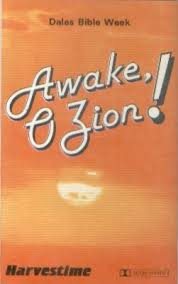
The Ballyphehane fellowship (or at least that’s what I called them) were again influenced by the British New Church Movement. Many of the songs we sung that year featured on the Awake Oh Zion tape, which consisted of music from the Dales Bible Week in 1981.
As with many fellowships from that period, the Ballyphehane group took different shapes as the years went by, but I see people from it in Grace Church and in the Celtic Prayer Centre now. You can hear all the music on the Vintage Worship Tapes site, but here are the ones that I remember best.
This one was based on Isaiah 52:1. Just as God was present in Zion or Jerusalem in the Old Testament days, the Holy Spirit dwells in the church now. That was very much the emphasis of that period.
Let us celebrate and dance. People sometimes danced during worship. We don’t do that in Baptist churches, but you do hear mention of it in Psalms. Not sure if I ever danced much myself, but you would do a lot of clapping.
We’d often begin meetings with this one. It’s based on Psalm 134:1-2. Even though the fellowships were new, many of the songs were based on the Old Testament and used the old King James version language.
Because this one was a slow one, I’d play it on the organ before the meeting started in the Baptist church. We’d sing the older hymns, but we’d also sing some of the new ones. I liked both.
I still hear this one in church these days. At the Baptist church, we were always a little hesitant about the second verse, I lift my hands. No-one forbade lifting hands, but it was a sort of a badge of the charismatic movement.
Again, this is one that lasted through the years, and I heard it in many different contexts. It’s based on Psalm 18.
Another excellent hymn that we sang everywhere. I remember hearing it when I visited David Pawson’s church in Millmead, Guildford in May 1982. He had left by then, but I did meet him at St. Marks, Kennington that October.
This is another one that we sung in all churches for many years after.
The start of this reminded me of the tune of Limerick You’re a Lady, a song that was very popular in Ireland in the late 1970s. Again, it lasted many years. Perhaps it’s still sung in some churches.
This excellent hymn always felt to me like a modern version of Onward Christian Soldiers.
I’m sure I was introduced to many of the older hymns too in 1982, but the new ones stand out in my memory. I was very keen on the new ones throughout the 1980s. Then, around 1990, I started liking the old ones more. But nowadays I like them all.
In 1982, as well as having interest in the charismatic scene, I became interested in church history and theology, particularly the theology of people like Luther and Calvin. And, I’d often listen to Church of England hymns, sung in Cathedrals etc. I had bought a few tapes of these in Killarney the year before. Many charismatics considered all this too churchy. And they had little interest in theology.
A big single that year was Ebony and Ivory by Paul McCartney and Stevie Wonder. I was a little uneasy about the line there is good and bad in everyone. Doesn’t Romans 3 say that we are all bad. Didn’t Jesus say No one is good—except God alone Luke 18:19? But in another sense, people do have the potential to do good things and bad things for others, whatever their religion. The song was about loving others but how often would you hear songs about loving God?
A London City Mission speaker, Neville Cobb, who visited the Cork YMCA, told me about a scheme that they ran for young people. Because I needed to be 21 to start my Teacher Training course at Thomond College of Education, Limerick, I had a year to spare. So I decided to apply. And to my surprise, I was accepted. So, I worked in Covent Garden and lived in Bermondsey until September 1983. I’ll cover this in my next post 😀.
In July 1982, Cliff Richard had a hit with The Only Way Out, which was a track from his Now You See Me, Now You Don’t album, which had a few Christian songs, including Little Town of Bethelem, which was released that Christmas. He had quite a few chart hits during that period, and I was quite impressed that he released Christian songs. You hear so many stories of people who begin in the gospel scene and then drop it all when they start having mainstream success.
Another 80s song with The Only Way in the title was The Only Way is Up, by Yazz and the Plastic Population in 1988. It sounded to me like a celebration of hedonism, but if you look at the lyrics, it’s more about a couple committing themselves to each other, for better or for worse.
I saw her on TV some years later and it turned out that she had become an evangelical Christian and was a member of a Baptist Church is Spain.
Finally, here’s some music, events, and films/TV shows that would have formed the background to 1982. I don’t necessarily endorse all the songs or films😀, but thinking of them takes me back to 1982.
10 Songs
- Come On Eileen – Dexy’s Midnight Runners & The Emerald Express
- Fame – Irene Cara
- Pass the Dutchie – Musical Youth
- Ebony and Ivory – Paul McCartney & Stevie Wonder
- Town Called Malice – The Jam
- A Night to Remember – Shalamar
- Heartache Avenue – The Maisonettes
- The Day Before You Came – Abba
- You Can’t Hurry Love – Phil Collins
- Take A Chance With Me – Roxy Music
10 Events
- IRA Bombings in London Parks
- Falklands War Begins and Ends
- Mark Thatcher Goes Missing in the Sahara
- Israeli Invasion of Lebanon
- China Announces Population Hits 1 Billion
- Hama Massacre in Syria
- Israel Completes Withdrawal from Sinai
- Anti-Government Protests in Poland
- Mary Rose Ship Raised from the Solent
- Sinclair ZX Spectrum Released
10 Films or TV Shows
- E.T. the Extra-Terrestrial
- Blade Runner
- An Officer and a Gentleman
- Gandhi
- The Dark Crystal
- Pink Floyd – The Wall
- The Hound of the Baskervilles
- The Young Ones
- The Tube
- Treasure Hunt
10 Famous People Who Passed Away
- Grace Kelly – Hollywood actress turned Princess of Monaco; died in a car crash
- Henry Fonda – Legendary actor, Oscar winner for On Golden Pond
- Ingrid Bergman – Swedish actress, star of Casablanca and three-time Oscar winner
- Thelonious Monk – Influential jazz pianist and composer
- Arthur Lowe – British actor known for Dad’s Army
- Gilles Villeneuve – Canadian Formula 1 driver, died in a racing accident
- Alex Harvey – Scottish rock and blues singer
- Marty Robbins – Country singer and NASCAR driver
- Stanley Holloway – Actor and comedian, famed for My Fair Lady and monologues in Cockney dialect
- Marty Feldman – British comedian and actor, famous for Young Frankenstein
 Hibernia Gospel