Assumption
The assumption is the belief that Mary was assumed body and soul into heaven. Scripture says nothing about this. The last we hear of Mary is on the day of Pentecost, where she’s one of the early disciples. While we see the New Testament as God’s word, we aren’t expected to believe in all the claims or legends that emerged after that. As the church grew, pagans would often bring in their old beliefs or merge them with Christian truth. People at the time were inclined to worship many different gods and goddesses. It’s easy to see how Mary came to be thought of as something like a goddess.
In the Old Testament, a man called Enoch was taken directly to heaven. Perhaps people thought that if this happened to Enoch, surely it must have happened to Mary. There was much debate on the assumption over the centuries. In 1950, Pope Pius XII made an ex-cathedra judgment when he declared the Assumption of Mary to be a dogma of the Catholic Church. So, Catholics are required to believe that Mary was assumed into heaven both body and soul. This is one of two ex-cathedra statements made by popes in the history of the church. The other one relates to the Immaculate Conception.
Immaculate Conception
This is the doctrine that Mary was conceived without sin. Again, there is no reason to believe that Mary needed to be without sin. Perhaps people feared that if she wasn’t without sin, then original sin would have been passed on to Jesus, in the way that genetic characteristics are passed on. But we should base our doctrine on Scripture rather than theological speculation. And we shouldn’t insist that the whole church should believe our speculations.
In his book Dawn or Twilight, Herbert Carson wrote the following:
“Bernard of Clairvaux, Thomas Aquinas and the Dominicans believed Mary was conceived with sin but was purified before birth. Dun Scotus popularized the idea that Mary was conceived without sin. There was a bitter battle between the Franciscans and the Dominicans on the matter. When the storms died down, the Pope defined it and decided that the church always held it. The definition of the Immaculate conception is rightly seen as a trial run for the doctrine of Papal Infallibility, to be defined 16 years later at Vatican I.
Pope Gregory the Great said “Christ alone was conceived without sin.” His reasoning and all the fathers leave no doubt in the matter. Tertullian, Irenaeus, Chrysostom, Origen, Basil, Cyril of Alexandria and others accuse Mary of many sins, arguing from biblical texts.”
Mary as the Mother of the Church
This doctrine is based on the following statement by Jesus to John at the cross:
John 19:26
When Jesus saw his mother there, and the disciple whom he loved standing nearby, he said to her, “Woman, here is your son,” and to the disciple, “Here is your mother.” From that time on, this disciple took her into his home.
The obvious interpretation here is that Jesus asked John to adopt Mary as his mother. John and Jesus were very close. We have no reason to believe that John represented the church or that Jesus was appointing Mary as the mother of the church.
Appearances in Lourdes, Fatima, Knock etc.
Evangelicals base their faith on the Scripture. Even the Catholic church is careful about claims of apparitions etc. I don’t remember the clergy being greatly enthused about the statue of Mary ‘moving’ in Ballinspittle Co. Cork back in 1985. They rightly believe that these can have a human explanation or can even be used by the devil to deceive. Evangelicals believe that new revelation ended with the New Testament. The Holy Spirit does illuminate the New Testament for us, but the next big event will be the return of Jesus.
The New Testament has frequent warnings about being led astray by false teaching and miracles etc; for example, Matt 24:24.
Matt 24:24
For false messiahs and false prophets will appear and perform great signs and wonders to deceive, if possible, even the elect.
Over the centuries, various people have claimed to see visions of angels and saints etc. Islam, Mormonism, and many other religions and cults are based on such claims. People might have experienced cures when they went to Lourdes, Fatima, or Knock. But given the amount of people who go there, such cures might have a human explanation, even if doctors can’t explain it. Doctors can’t always explain why illnesses disappear. Even an atheist doctor might be happy for you to believe that it was a miracle. Sometimes, the diagnosis might even have been incorrect to start with. Even in evangelical healing crusades, you might see someone emerging out of a wheelchair, but not everyone in a wheelchair is totally incapable of standing or walking.
Some worry that Satan might cure somone to draw people into false doctrine. And it’s even possible that God himself might cure people if they are reaching out to him in prayer, even if they’re confused about doctrine. You get Evangelicals making strange claims too sometimes, such as God speaking to them audibly or maybe an angel. We might not rule out such claims completely, although most people that I know would be sceptical about such events. But it’s unwise to base doctrine on such shaky foundations.
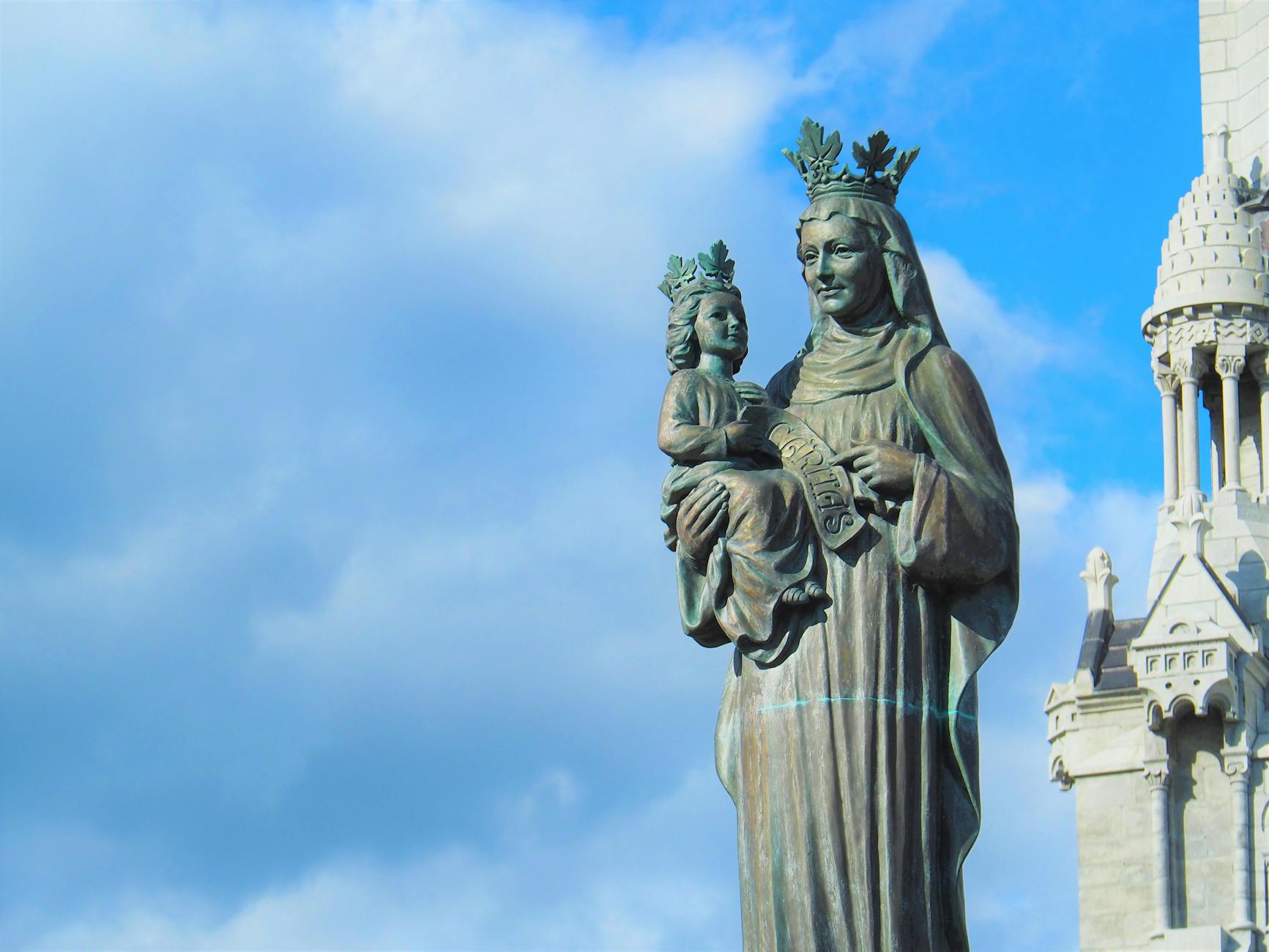
Statues and Holy Pictures
The second commandment, which the Catholic church class as part of the first commandment, warns against making images of God or even making images of earthly things. It’s likely that this relates to images used for religious purposes rather than normal paintings or photographs, though some interpret it to mean any type of image. Here is what it says:
Exodus 20:4-6
“You shall not make for yourself an image in the form of anything in heaven above or on the earth beneath or in the waters below. You shall not bow down to them or worship them; for I, the Lord your God, am a jealous God, punishing the children for the sin of the parents to the third and fourth generation of those who hate me, but showing love to a thousand generations of those who love me and keep my commandments.
There is no evidence of image use in the New Testament. Over the centuries, the church drifted into using them, though there was much debate. In some ways, for illiterate people, maybe they served as a teaching aid. Evangelicals prefer to avoid them, based on the second commandment. Here is what the Council of Trent said about images:
“It is lawful to have images in the church and to give honour and worship to them…. Images are put in churches that they may be worshiped.“
At the opening of the Second Vatican Council, Pope John XXIII stated,
“I do accept entirely all that has been decided and declared at the Council of Trent.”
Anyway, to conclude, we regard Mary as an evangelical Christian. The real Mary has very little to do with the legendary Mary. Given how invested the Catholic church is in the legendary Mary, it would be very difficult for them to roll back and say they were mistaken all along.
Think of what Pope Leo 13th said in an encyclical:
‘Nothing is bestowed on us except through Mary, as God himself wills. Therefore as no one can draw near to the supreme Father except through the Son, so also one can scarcely draw near to the Son except through his mother.’
You do get evangelical Catholics, but I often wonder if they really do sign up to all that Mary stuff. Perhaps, they feel that if liberal Catholics feel free to pick and choose what parts of the Bible and church teaching they believe, why shouldn’t evangelical Catholics be free to choose which parts of church teaching they believe.
Mary as Co-redemptrix
This doctrine was, thankfully, denied by Pope Francis in 2021. But the cult of Mary within the church does sometimes exalt Mary to suggest that our redemption is at least partly in her hands:
- Bishop De Liguori: “The way of salvation is open to none otherwise than Mary” and since “our salvation is in the hands of Mary…He who is protected by Mary will be saved, he who is not will be lost.“
- Vatican II taught that she was united with Christ in suffering as he died on the cross and that she co-operated in the Saviour’s work of restoring supernatural life to souls.
- In ‘The Glories of Mary’ Liguori says “If God is angry with a sinner, and Mary takes him under her protection, she withholds the avenging arm of her Son and saves him.”
- At Fatima the child Jesus is said to have spoken as follows: “Have pity on the heart of your most holy mother. It is covered with the thorns with which ungrateful men pierce it at every moment.
This is all very strange to evangelicals, who see Mary as their sister in Christ, which is the view we have of her in the book of Acts. The last recorded message we have of her is at the wedding feast of Cana when she directed people towards Jesus. It feels very much like people over the centuries knew very little of the New Testament, or found it boring and thought it necessary to build a new religion, loosely based on it. At the reformation, Luther and others took a fresh look at the New Testament and sought to reform the church accordingly.
 Hibernia Gospel