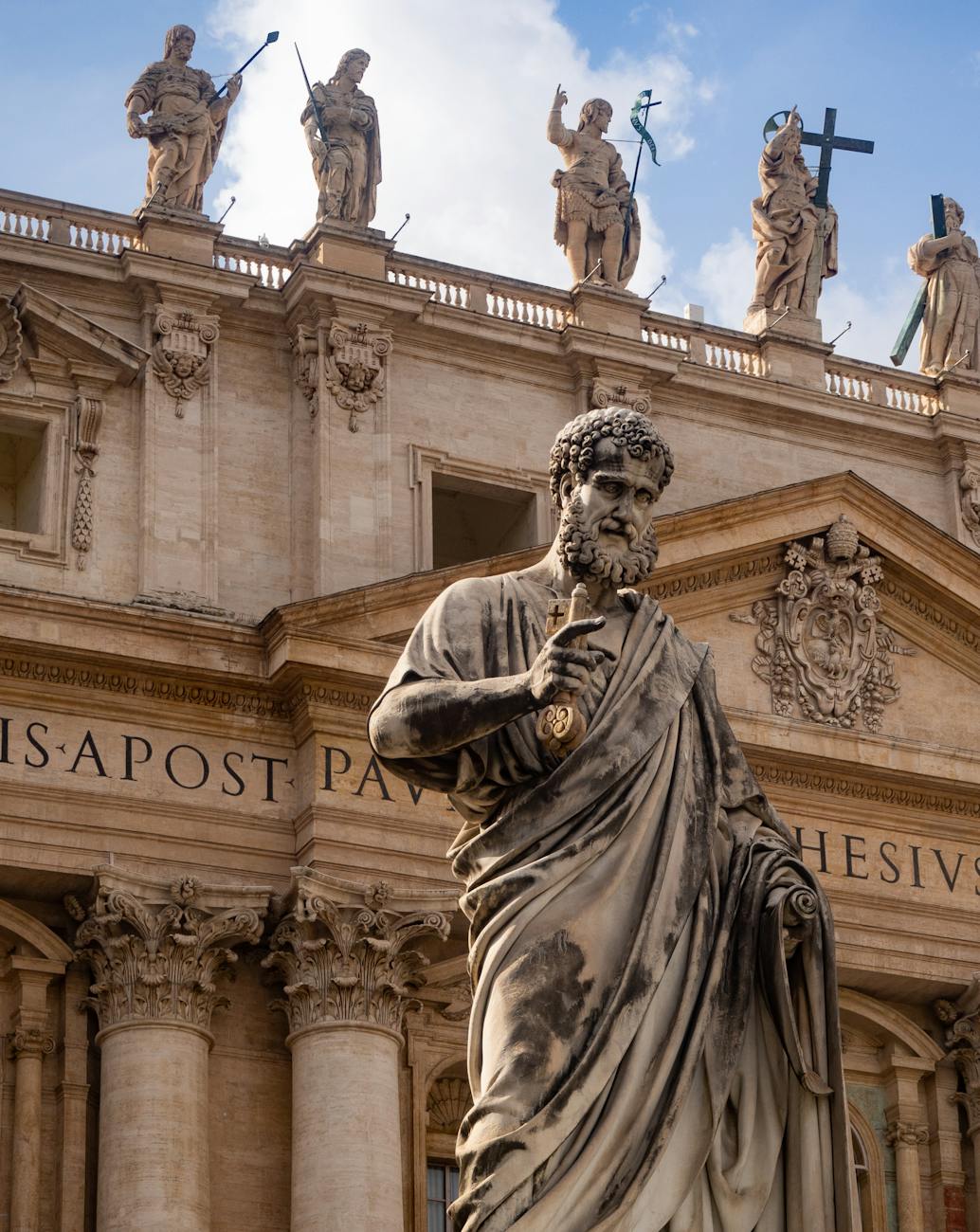
Well, as a Catholic, I was always told that the Catholic church was the official church. Jesus told Peter that he was the rock on which he would build his church. Peter was the first pope, and all the Catholic bishops were the successors of the apostles, and bishops of Rome were the successors of Peter.
Pope Boniface VIII decreed the following:
“The breast of the Roman Pontiff is the repository and fount of all law. This is why blind submission to his authority is essential to salvation.”
So how do I view things now? The term church is used in different ways in scripture. Without getting too technical, we can think of a local church as a fellowship of believers meeting together. Then, there’s the Catholic or universal church, which consists of all believers who’ll be in heaven. This is to be distinguished from what became the Roman Catholic denomination.
Initially, on the day of Pentecost, the church met in Jerusalem, with the 12 apostles in charge. Soon, the apostle Paul was converted, and he was a major influence on the development of the church. Over time, local churches were founded throughout the Roman empire. Some, like the church in Corinth, seemed a little disorganized. But as time went on, leaders were appointed in local churches. They’re never called priests in the New Testament. Terms like elders, overseers, bishops, or pastors were used. Initially, these described the leaders of local churches. It’s easy to see, that over time, churches in the larger cities became more influential, and a pastor of a large church would have a big influence on other churches. This even happens in modern evangelicalism. London has had a lot of big names, as have various US cities.
In the early church, after the New Testament was completed, the term bishop came to be associated with those influential figures. Rome became the most influential. It came to be believed that Peter was the first bishop of Rome. We don’t have any real evidence for this in Scripture, and little in history, although most accept that he died a martyr’s death in Rome. List of bishops found in Hegesippus, Ireneus and Eusebius gives as first bishop of Rome, not Peter, but Linus. The apostles were never bishops. They were very much a class above the standard church leaders.
The early church, like any organization, had its fair share of divisions and disputes. At one stage the “rock” verse was used to argue that Jesus appointed Peter the head of the church. Because Peter was believed to be the first bishop of Rome, all who followed were also the head of the church. It was not until the 4th Century that Roman bishops such as Damasus and Leo used it to undergird the papacy.
Let’s look at that passage in Matthew, where Jesus makes reference to Peter’s name, which means rock or stone.
Matthew 16:13-19
When Jesus came to the region of Caesarea Philippi, he asked his disciples, “Who do people say the Son of Man is?” They replied, “Some say John the Baptist; others say Elijah; and still others, Jeremiah or one of the prophets.” “But what about you?” he asked. “Who do you say I am?” Simon Peter answered, “You are the Messiah, the Son of the living God.” Jesus replied, “Blessed are you, Simon son of Jonah, for this was not revealed to you by flesh and blood, but by my Father in heaven. And I tell you that you are Peter, and on this rock I will build my church, and the gates of Hades will not overcome it. I will give you the keys of the kingdom of heaven; whatever you bind on earth will be bound in heaven, and whatever you loose on earth will be loosed in heaven.”
In the 17th century, a French Roman Catholic scholar, Jean Launoy researched how the early church fathers interpreted this passage:
- 17 said the rock was Peter
- 44 said the rock was Peter’s faith
- 16 said the rock was Christ
- 8 said the rock was all the apostles
So, most understood the rock to mean Peter’s confession, not Peter himself. The fact that Jesus is the Messiah, the Son of the living God was what the church would be founded on rather than Peter himself. St. Augustine initially said that the rock was Peter but later said it was Peter’s faith. Then, he said everyone should decide for himself.
However, some did view Peter as the rock or foundation. But even if Peter could be considered a founder of the church, it didn’t mean that he was appointed as Pope, or that he had successors. Clearly, anyone watching on the day of Pentecost would have seen Peter as the main man. As time went on, Paul appears to have become more prominent. And in Acts 15, when the church met to sort out a controversy, Peter was merely one of the participants. He wasn’t called upon to make an infallible judgement.
Certainly, Peter could be classed as a foundation, but so were all the Apostles (See Eph 2:20), and ultimately Christ himself (See 1 Cor 3:11).
As evangelicals, we focus on modelling our churches on the New Testament church. A reasonable question one might put to us is this. If you had lived in AD 100, when all the apostles were dead, how would you have organized the worldwide church? Would things have been better if local churches were simple fellowships with only informal links between them? How practical would this have been?
Well, perhaps it’s best to see Christianity as a movement that began with Pentecost. Like any movement, there were different factions and some were downright heretical. The movement developed differently in different regions. And there were frequent persecutions, initially from the Jews, but later across the whole Roman Empire. In modern times, evangelical churches are often local independent fellowships, a bit like local shops. But sometimes it makes sense to have associations consisting of local entities across the country. And in some cases, international cooperation might be beneficial. In the early church, such cooperation was needed for missionary work, for agreeing which books constituted the New Testament, and also to agree on the fundamental doctrines of the faith, which were expressed in various creeds. And of course, false teachers and movements needed to be sidelined.
So over time, an organization developed with major bishops in places like Rome, Antioch, Jerusalem, Alexandria, and Constantinople. There needed to be a proper denomination and people needed to decide what the proper New Testament was and what the proper doctrines were. When the Roman empire fell, particularly in the Western region, Rome became the centre of Christendom. The Eastern church never accepted Papal supremacy. And you’d get plenty of areas that had little to do with Rome, such as Africa and the Celtic church here in Ireland. And there were always disputes and various reforms within the church long before the reformation, as happens today.
Let’s return to my illustration of local shops cooperating. Let’s say they develop into a powerful international organization. That might be a good thing, but not necessarily. As the saying goes, power corrupts, and absolute power corrupts absolutely. History shows how dangerous and damaging it can be when an organization becomes too powerful. We might find it upsetting that Christendom is divided, but disagreement can be a healthy thing, once we respect each other.
Evangelicals don’t view the early church as the Roman church. The Roman church developed out of it, as did churches in Eastern Europe, Africa, Ireland and elsewhere. And of course, the Protestant churches developed out of the Roman church. Evangelical churches are often simple in their structure, but you do get movements of evangelicals in the mainline denominations, including in the Catholic church. We all like people to join our own church, but what really counts is that people belong to Jesus.
So, to conclude, no, Jesus didn’t appoint Peter the first Pope, but the New Testament consists of the teaching of the apostles. So, Peter, Paul and others, and fundamentally, the Holy Spirit, leads the church through the Scriptures. At a secondary level, we have our local leaders and many contemporary and historical teachers who can influence us. And of course, we can all encourage one another, share our thoughts, and recommend resources. But our sole authority is the Word of God.
We can understand how the Roman Catholic church developed. Some Protestants see it as a sinister or even a Satanic development, with the Pope being the anti-Christ. In fact, this accusation was first made from within the Roman Catholic church. But if you could go back in time and put an Evangelical guy in charge of it all, would that have solved all the problems? I think not 😀. But whatever shape Christendom takes, there will always be individuals who come to true faith in Jesus. You can see this in the Old Testament too. So much of it paints a depressing picture of organized religion, but the Psalms are examples of genuine personal faith, which is what counts.
I have heard modern Catholics argue that the papacy and other aspects of the Roman Catholic church structure aren’t found in Scripture, but that these developed over the centuries under the guidance of the Holy Spirit. Would God really allow his church to go off track? But it’s clear that divisions and disagreements have always existed within the Catholic church or within any denomination. And even Popes have occasionally drifted into false doctrine and all sorts of scandals, as outlined in Peter De Rossa’s Vicars of Christ.
And could you not argue that the Protestant reformation could well have been guided by the Holy Spirit, to get Rome back on track? Anyway, it’s clear that the Holy Spirit has preserved the Scripture, and most of the churches within Christendom have thankfully stuck with the fundamental teachings outlined in the creeds. We can put that down to the providence of God.
The Holy Spirit does guide, but we should always be willing to accept that our understanding might be wrong and be willing to examine it in the light of Scripture. Even within evangelicalism, now and then, a theologian might produce a novel understanding of some doctrine. We are all quick to come down on the person like a ton of bricks. But before we do, we should have a fresh look at Scripture and see if the person might have a point. Even if we don’t agree, we might accept that it’s a legitimate opinion.
 Hibernia Gospel